What Does a Claim Payment Cost Per Transaction by ACH, Virtual Card, or Digital Check?
The published per-rail numbers, and why two of the three are not published.
The bottom line
A per-rail price list is the first thing most procurement teams ask for. Here is ours, as far as it is published, along with the reason it will not settle the decision on its own.
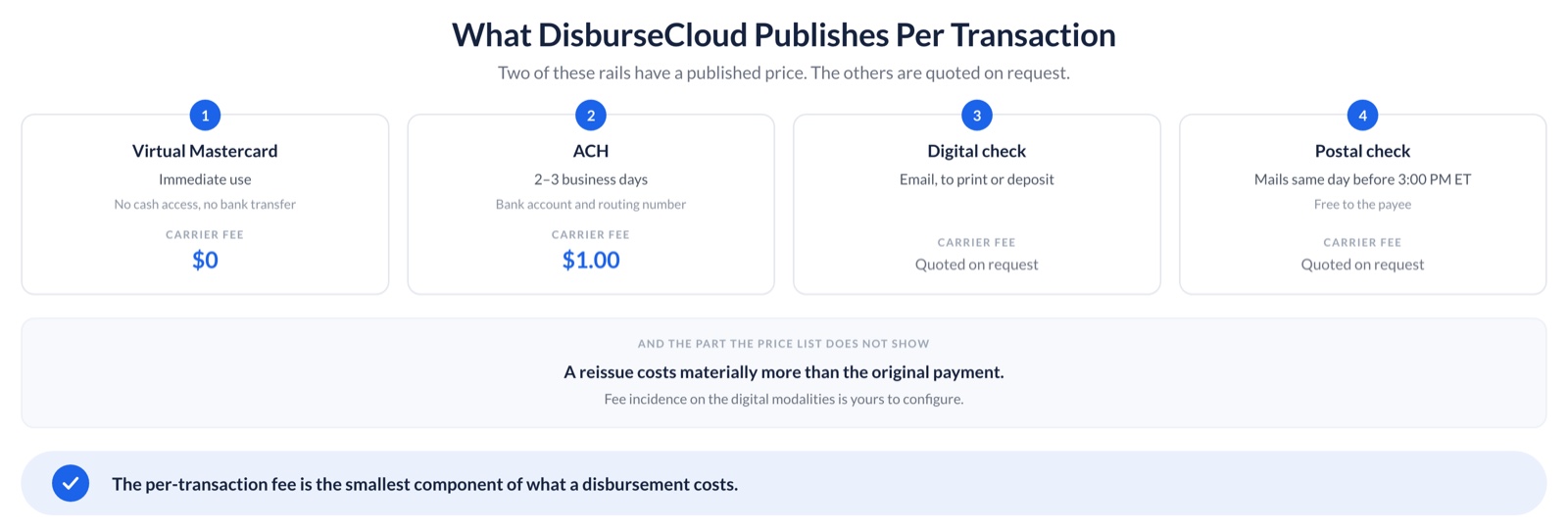
That reason, briefly: the per-transaction fee is the smallest component of what a disbursement costs. The largest driver is whether the payment succeeds on the first attempt, and the cheapest control on first-attempt success is letting the payee choose the method. A price list cannot show you that, but your own reissue rate can.
What is published
| Modality | Carrier fee | Speed |
|---|---|---|
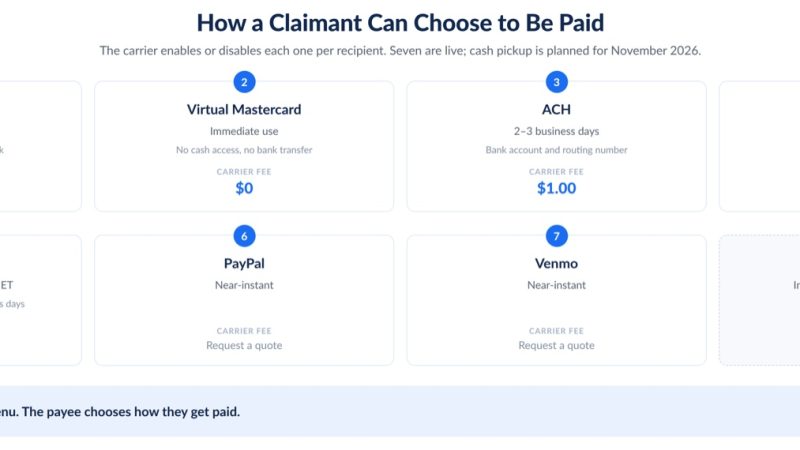
| Virtual Mastercard | $0 | Immediate use |
| ACH | $1.00 | 2–3 business days |
| Postal check | Quoted rather than published | Mails same day before 3:00 PM ET |
| Digital check | Quoted rather than published | Email, to print or deposit |
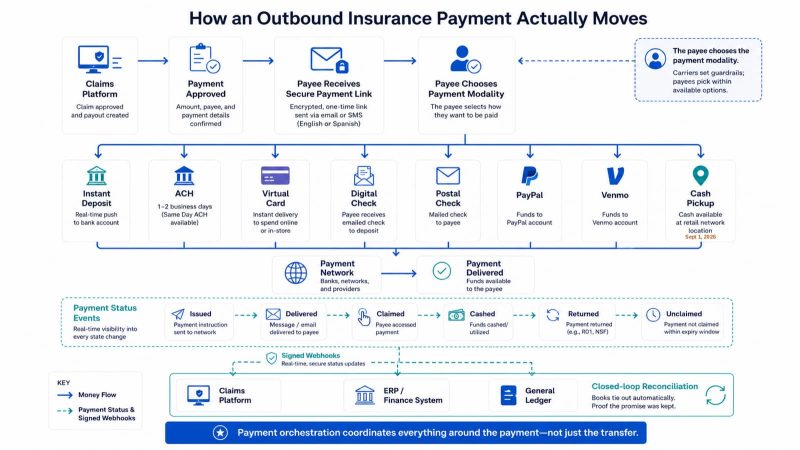
| Instant deposit | Quoted rather than published | 1 to 5 minutes, personal debit card only |
| PayPal | Quoted rather than published | Near-instant |
| Venmo | Quoted rather than published | Near-instant |
| Cash pickup | Quoted rather than published | In person, live 1 November 2026 |
Fees as published on the DisburseCloud pricing page, 8 September 2026. Six of the eight are quoted rather than published. The postal check figure is the carrier’s fee; the postal check is free to the payee.
Two of the three rails in the question above have a public number: virtual card at $0 to the carrier, and ACH at $1.00. Digital check does not. It is quoted on request, as are instant deposit, PayPal, Venmo, and cash pickup. We are not going to publish an estimate in place of a quote; ask and we will give you the figure.
The $0 figure on virtual card is worth reading with the product in view. It is a virtual Mastercard, spent as a card: there is no cash access and no transfer of the balance into a bank account. It does not expire, and the payee can add it to a digital wallet if they want to. A payee who needs the money in an account should take ACH or instant deposit, and instant deposit needs a personal debit card at a standard bank, which rules out prepaid cards, business accounts, and some digital-first and neobank accounts. Fee is one input into the modality mix. Reach is the other.
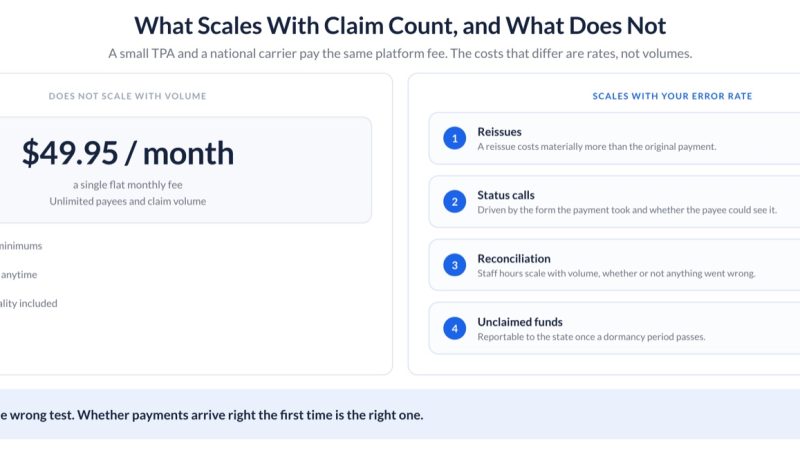
Access to every modality is included in the $49.95 per month platform fee, flat, with unlimited payees and claim volume and no per-transaction minimums. The per-transaction fees above sit on top of that, and who absorbs them is configurable. A one-time setup and onboarding fee applies and is quoted rather than published.
Who pays the fee is a setting, not a fixed cost
On the digital modalities — ACH, instant deposit, digital check, Venmo, and PayPal — the carrier decides who absorbs the fee: participate in full, contribute a percentage or a fixed dollar amount, or not participate, in which case the payee absorbs it. Full payee absorption is the common configuration.
The payee sees the fee attached to each available method before choosing, and the gross disbursement, the fee, and the net amount after choosing, which they have to accept to proceed. On a $500 ACH disbursement with the fee passed through, the payee nets $499.00 and the carrier’s additional cost is $0.00. With the carrier covering it, the payee nets the full $500.00 and the carrier pays $1.00.
Confirm the disclosure treatment with your own teams
How fee disclosure is documented varies by state and by line of business, and the disclosure trail is usually what a compliance team wants to see rather than the fee schedule itself. Confirm the treatment with your own compliance and legal teams; nothing here is legal or regulatory advice.
Why the price list will not settle it
Because the per-transaction fee is the smallest component of what a disbursement costs. The most-cited outside benchmark makes the point: the 2022 AFP Payments Cost Benchmarking Survey puts the median transaction cost of issuing a paper check at $2.01 to $4.00, unchanged from its 2015 report.¹
The useful part is not the headline range, it is what sits inside it. AFP reports internal and external costs separately — a median of $1.78 for the first and $1.00 for the second — and the variables feeding those figures are almost entirely operational: staff time, the stock a check is printed on, print and postage costs, bank lock-box charges, and the continuing work of positive-pay matching and escheatment tracking.¹ In other words, the figure people quote as a transaction fee is already a total operational cost, with the recovery work counted inside it. It is also a measure of running check issuance in-house, which is a different thing from what a check costs as an instrument. On DisburseCloud a postal check is free to the payee and mails the same day when the disbursement is submitted before 3:00 PM Eastern.
Two different quantities
AFP is measuring what it costs an organization to run a payment method itself: its own bank fees, its own staff, its own systems. That is not the same thing as a vendor price, which also covers payee support, screening, status reporting, and exception handling. Setting one beside the other and reading the gap as a saving compares two different things.
A reissue costs materially more than the original payment, because the original cost is already spent and the recovery adds a stop-pay fee, staff time, payee contact, a second issuance, and a second pass through reconciliation. If your reissue rate is a few percent, that tail is a meaningful share of total disbursement cost, and it is usually recorded in three different places, so nobody sees it as one number. We set out the arithmetic in what an outbound claim payment actually costs.
The lever with the most effect on that is first-attempt success, and the cheapest control on first-attempt success is letting the payee choose the method. For the full cost model, including the loaded-cost methodology and the fraud and escheatment exposure that sits behind each rail, see the August guide linked above.
Get the quoted numbers
If a modality fee is the figure blocking your model, ask for it directly. It is quoted rather than withheld.
Frequently asked questions
How much does an ACH claim payment cost?
The published modality fee is $1.00. Whether the carrier or the payee absorbs it is configurable.
What does a virtual card cost?
Virtual card is published at $0 carrier fee.
What does a digital check cost per transaction?
It is quoted rather than published, as are instant deposit, PayPal, Venmo, and cash pickup. Request the figure rather than relying on an estimate.
Is there a per-transaction minimum?
No. The published pricing states no per-transaction minimums, with unlimited payees and claim volume on the $49.95 per month platform fee.
Sources
- 1. Association for Financial Professionals, 2022 AFP Payments Cost Benchmarking Survey: Comprehensive Results, pp. 14–16. https://assets.ctfassets.net/h83dujey17us/59MRqbPnl4xJU0UufqxrhS/e84dc98d4d671e163a03b5489c202e35/2022_AFP_Payments_Cost_Survey_Final_Report__u1_.pdf
- DisburseCloud Pricing — https://www.disbursecloud.com/pricing/
- DisburseCloud FAQ — https://www.disbursecloud.com/faq/
- What an Outbound Claim Payment Actually Costs, 18 August 2026 — https://www.disbursecloud.com/blog/what-an-outbound-claim-payment-costs/
Nothing in this article is legal, tax, or regulatory advice. Escheatment, unclaimed property, 1099, and OFAC obligations vary and belong with your own counsel.