Is DisburseCloud Worth It for a Small TPA Processing Under 5,000 Claims a Month?
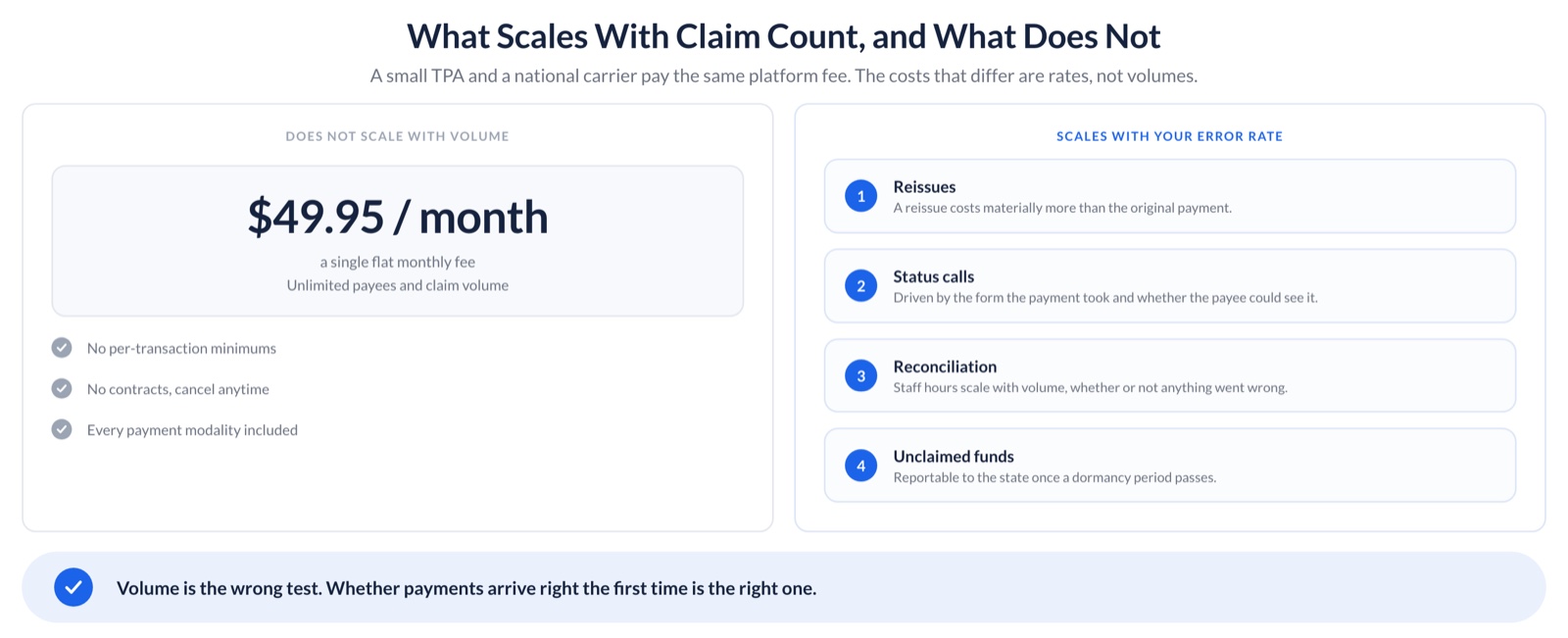
Volume is the wrong test. The platform fee does not scale with your claim count, and the costs that do scale are rate-driven.
The bottom line
A TPA paying 500 claims a month and a carrier paying 500,000 pay the same published platform fee: $49.95 per month, flat, plus a one-time setup and onboarding fee that is quoted rather than published. Unlimited payees and claim volume, no per-transaction minimums, no contract. The fee does not multiply by the number of carrier programs you administer.
The real test is whether you have the failure modes: reissues, “where’s my payment?” calls, month-end reconciliation done by hand, and unclaimed funds aging toward escheatment. Those are rates. Whatever your reissue rate turns out to be, it costs you that same share of your payments whether you run 500 a month or 50,000.
“Overkill” is a reasonable instinct, and it is worth testing rather than dismissing. If you run a lean operation, the question to put to any platform is whether it assumes a claims-ops department or a claims-ops person.
This article covers the specific case: a TPA under 5,000 claims a month, deciding whether a managed disbursement platform is proportionate. It covers what the published pricing actually is, why claim count is the wrong variable, and the cases where the honest answer is that you do not need this yet.
The costs that hurt a small TPA are the same costs that hurt a large carrier. They just arrive as a bigger share of a smaller team’s week.
What does it actually cost at this volume?
DisburseCloud publishes its pricing rather than gating it, so this part is checkable.
| Line | Published price |
|---|---|
| Platform fee | $49.95 / month, flat · no contracts · cancel anytime |
| Claim volume | Unlimited payees and claim volume |
| Per-transaction minimums | None |
| Setup & onboarding | One-time fee, quoted rather than published |
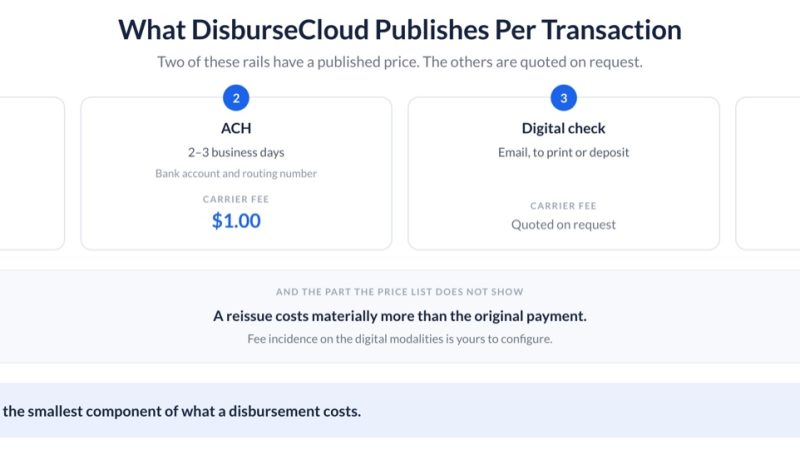
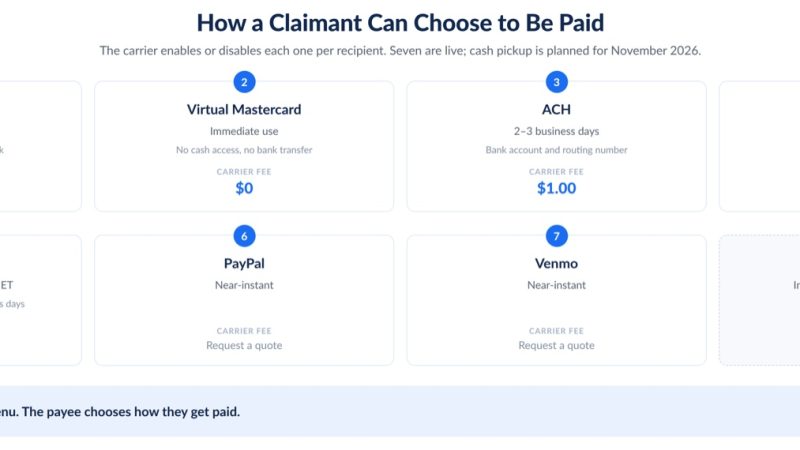
| Virtual Mastercard | $0 carrier fee |
| ACH | $1.00 |
| Postal check | Quoted rather than published |
| Instant deposit, digital check, Venmo, PayPal | Quoted rather than published |
| In-person cash pickup | Quoted rather than published · live November 2026 |
Fees as published on the DisburseCloud pricing page, 8 September 2026. The postal check fee shown is the carrier’s; the postal check is free to the payee.
Two things follow that matter specifically at low volume.
The platform fee is flat, so your per-claim cost falls as volume rises, and at low volume it is still small in absolute terms. At $49.95 a month you are not amortizing a six-figure license across a small book. The fee is the fee, and it stays the fee whether you administer one carrier program or six.
Most of the per-transaction cost is configurable. On the digital modalities — ACH, instant deposit, digital check, Venmo, and PayPal — a carrier can absorb the fee in full, contribute a percentage or a fixed dollar amount, or not participate, in which case the payee absorbs it. Full payee absorption is the common configuration.
Get the quoted numbers before you model
The one-time onboarding fee and six of the eight modality fees are quoted rather than published. For a small TPA those are the swing factors in a real business case. Ask for them in writing before modeling anything.
Why claim count is the wrong variable
The costs that make outbound payments expensive do not scale with how many claims you approve. They scale with how often a payment goes wrong.
A reissue costs materially more than the original payment, because the original cost is already spent and the recovery adds a stop-pay fee, staff time, payee contact, a second issuance, and a second pass through reconciliation. The multiplier is set by your reissue rate, so the arithmetic lands the same way at any size. We walked through that arithmetic in detail in what an outbound claim payment actually costs.
- Status calls. “Where’s my payment?” is a symptom with two causes: the payment went out in a form the payee did not want, or on a timeline they could not see. Both are rate-driven. At a small TPA these calls land on the adjuster who has other work.
- Reconciliation. If payment status does not report back automatically, finance reconstructs it later from bank statements. That cost scales with volume rather than with problems: you pay it whether or not anything went wrong. A small team feels this as a fixed weekly tax.
- Unclaimed funds. Funds issued but never claimed become reportable to the state once a dormancy period passes. Whether you catch that early depends on whether unclaimed arrives as a reported status change or as a balance that will not reconcile. Dormancy rules vary by jurisdiction and belong with your compliance counsel.
The one number worth building yourself
Published benchmarks orient you; they do not make a business case. Pull one quarter of your own outbound payments and fill this in.
| Line | What to pull | Why it matters |
|---|---|---|
| 1. Volume by method | Count of payments by modality | The mix, not the average, drives the total |
| 2. Reissue count | Payments that required a second issuance | Captures the recovery cost, not just the original |
| 3. Status-call volume | Inbound payment-status contacts | Convert to staff hours, not tickets |
| 4. Reconciliation hours | Staff time matching payments monthly | Scales with volume, not with problems |
| 5. Unclaimed / stale-dated | Payments aged past their window | The longest-dated cost, usually unbooked |
One trap to avoid when you compare
A small operation’s internal cost feels close to zero, because it is absorbed into an adjuster’s week rather than invoiced. A managed service price is visible and itemized. Those are different quantities: one is what it costs you to run the process yourself, the other is a price that also covers payee support, screening, status reporting, and exception handling. Set them side by side and the comparison usually falls apart in procurement. Compare like with like, or compare outcomes instead.
If lines 2 through 5 are close to zero, you genuinely may not need this yet. That is a real outcome, and it is the next section.
When it probably is overkill
An honest answer has to include the cases where the answer is no.
- You pay a small number of payees, all on one rail. If everything is ACH to established vendors with a near-zero return rate, the failure modes this platform addresses are not in your operation.
- Your payments go to repeat counterparties. Payee choice does the most work when you are paying someone once and do not already know how they can receive money. It does least when you are paying the same counterparties every month.
- You have no reconciliation burden. At a handful of payments a week, a spreadsheet is not a scandal.
- Someone else owns disbursement in your stack. If your carrier client mandates their own payment platform, the decision is not yours to make.
The distinguishing question is size-independent. What matters is whether the payments you send arrive correctly the first time, and whether you can see their state without making a phone call.
Where a small TPA feels the difference
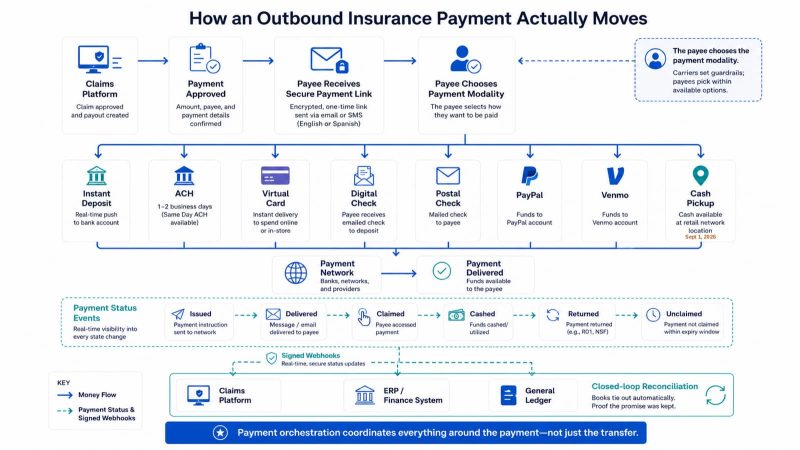
- The payee picks the method. This is the part that removes status calls rather than answering them faster. Every live modality is presented to the payee — ACH, virtual Mastercard, instant deposit, postal check, digital check, Venmo, PayPal, and in-person cash pickup from November 2026 — and the payee selects the one that fits their circumstances. A claimant without a bank account is not a support escalation. A claimant who wants paper gets paper, at no cost to them. The call you never receive is the cheapest call you will ever handle.
- Payee support is handled, not routed to you. Bilingual English and Spanish payee support is handled for you rather than routed to your team. At a large carrier that displaces contact-center headcount. At a small TPA it displaces the adjuster’s afternoon.
- Exceptions do not become a paperwork project. A lost postal check is reissued by stop payment at 15 business days, with no affidavit required. An ACH sent to the wrong account is reissued once the return posts. At a small TPA the affidavit chase is the part that eats an afternoon nobody budgeted for.
- A named CSM from day one. The $49.95 tier includes a named CSM rather than a shared ticket queue. At a large carrier that is a convenience. At a small TPA it is often the difference between a payment question resolving today and resolving next week.
- You can start without an integration project. Typical go-live is four to six weeks, with portal, API, and SFTP batch routes available depending on how much automation you want on day one. A small TPA can start on the portal and add the API later; the integration is not the entry ticket.
Where DisburseCloud fits
DisburseCloud is built for carriers, MGAs, TPAs, and claims organizations. The pricing model does not distinguish between them by size: $49.95 a month, flat, unlimited payees and claim volume, no per-transaction minimums, no contract.
DisburseCloud is the outbound payment platform. Tranzpay, from the same company, is the inbound payment platform, so a carrier can manage both directions of the payment lifecycle through one relationship.
On the specifics that bear on this decision: every live payment modality is included in the plan, with in-person cash pickup live from November 2026; every state change is returned to your system as a webhook in milliseconds, including the modality the payee selected; ledgers are segregated per line of business; and the platform is SOC 2.
See it run on a sample claim
A 30-minute walkthrough with a CSM, using your line of business and your claims system: the adjuster view, the payee view, and the status trail end to end.
Frequently asked questions
Is there a minimum claim volume to use DisburseCloud?
No. The published pricing lists unlimited payees and claim volume with no per-transaction minimums, at $49.95 per month with no contract.
Does the $49.95 multiply if I administer several carrier programs?
No. It is a single flat monthly fee.
What does a small TPA actually pay per payment?
It depends on the modality mix and on who absorbs the fee. Virtual card is published at $0 carrier fee and ACH at $1.00. Fees for the remaining six modalities are quoted rather than published, as is the one-time setup and onboarding fee.
Can a TPA pass payment fees to the payee?
On digital modalities, yes: in full, by percentage, or by a fixed dollar amount. The payee sees the fee before selecting a method, and the gross, fee, and net amount after selecting one.
How long does a small TPA take to go live?
Typical go-live is four to six weeks, using a portal for a quick launch, an API for automation, or SFTP batch upload for high-volume processing.
Does a small TPA get the same support as a large carrier?
Yes. The $49.95 tier includes a named CSM rather than a shared ticket queue.
Do we have to change banks?
No. The platform works alongside existing banking relationships.
Sources
- DisburseCloud Pricing — https://www.disbursecloud.com/pricing/
- DisburseCloud Platform Features — https://www.disbursecloud.com/features/
- DisburseCloud FAQ — https://www.disbursecloud.com/faq/
- What an Outbound Claim Payment Actually Costs, 18 August 2026 — https://www.disbursecloud.com/blog/what-an-outbound-claim-payment-costs/
Nothing in this article is legal, tax, or regulatory advice. Escheatment, unclaimed property, 1099, and OFAC obligations vary and belong with your own counsel.