What an Outbound Claim Payment Actually Costs: A Financial Leader’s Guide
The per-transaction fee is the smallest part of what a disbursement costs, and who pays it is a configuration choice.
The bottom line
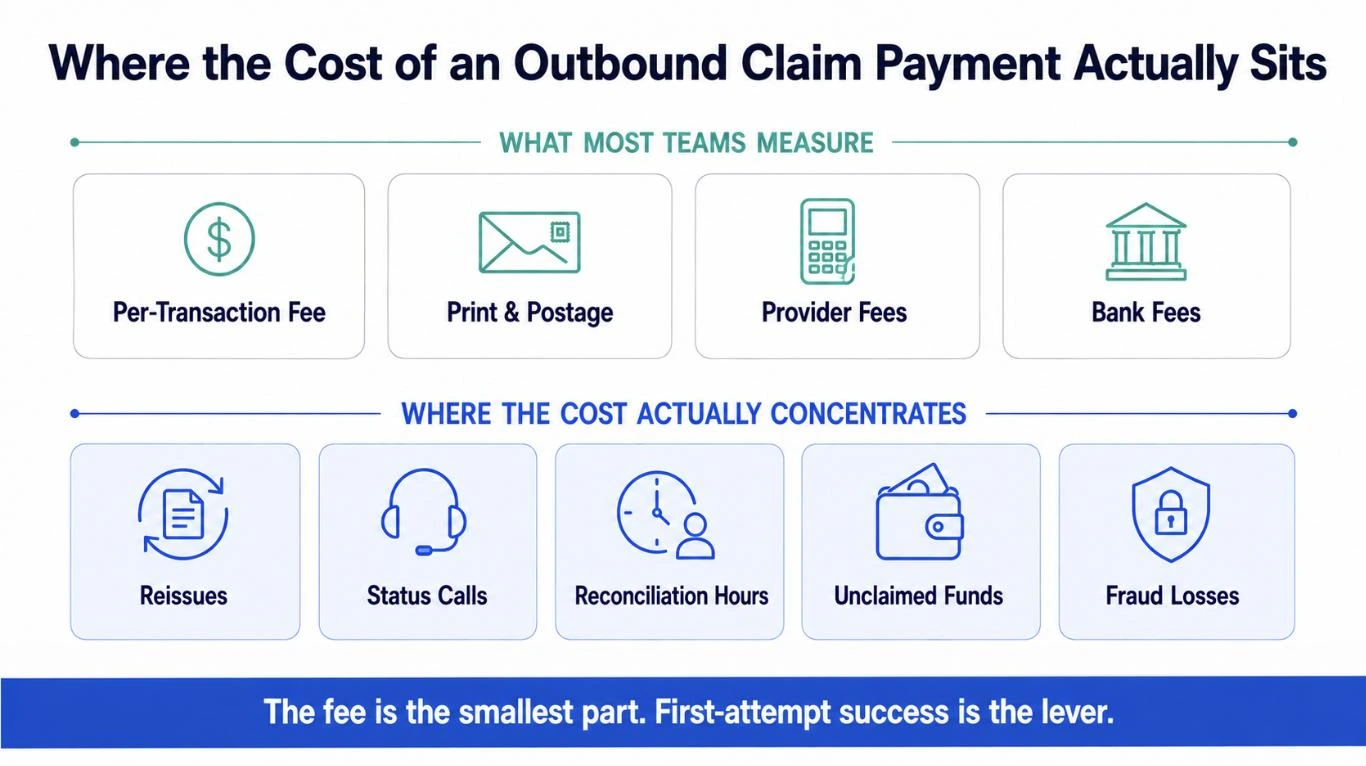
Most cost conversations about outbound payments start and end with the per-transaction fee. It’s the easiest number to get and the least useful one to manage, for two reasons.
The first is that it’s the smallest component of what a disbursement costs an insurance operation. The expensive part happens after the money leaves: a payment that arrives in a form the payee can’t use becomes a call, then a reissue, then a second reconciliation. A check that never gets deposited becomes a stop-pay, then an aging liability, then a state filing.
The second is that the fee isn’t necessarily yours to pay. Who bears it is a configuration decision, and it has more effect on payee behavior — and therefore on your operational cost — than the fee itself.
This guide covers the outbound side only: what happens after a claim is approved.
Where the cost of a disbursement actually sits
The most-cited benchmark is AFP’s Payments Cost Benchmarking Survey. Its median cost to issue a paper check is $2.01 to $4.00.1
The useful part isn’t that headline figure, it’s the methodology behind it. AFP builds those numbers from external costs — bank and provider fees — and internal costs including personnel, IT, fraud liability, account validation, and voids and reissues.2 The benchmark that gets quoted as a transaction fee is already a total operational cost figure, with reissues as a line item inside it.
A word of caution on how those benchmarks get used. AFP is measuring what it costs an organization to run a payment method itself — its own bank fees, its own staff, its own systems. That is a different quantity from what a managed disbursement service charges, which covers issuance plus payee support, compliance screening, status reporting, and exception handling. Setting a self-operated internal cost next to a managed service price and reading the gap as a saving compares two different things, and the comparison usually falls apart in procurement. Neither number is wrong; they answer different questions.
Which is why the figure worth managing isn’t a per-payment price at all.
What a single reissue really costs
A single reissue can cost more than twenty first-attempt payments. The original cost is already spent. On top of it: a stop-pay fee, the staff time to place it, the payee contact to arrange a new method, a second issuance, and a second pass through reconciliation. If your reissue rate is a few percent, that tail is a meaningful share of total disbursement cost — and it’s usually recorded in three different places, so nobody sees it as one number.
The lever with the most leverage is the first-attempt success rate.
Who pays: the configuration decision most carriers underthink
On the DisburseCloud platform, fee incidence is configurable everywhere except one place, and that exception is the load-bearing part.
The postal check is always billed to the carrier. There is no setting that charges a payee for a mailed check — not a partial one, not a reduced one. It is not a default that can be changed; the option doesn’t exist.
Every other modality is splittable. The carrier can participate in the fee on a percentage basis or as a fixed dollar amount, or not participate at all, in which case the payee absorbs it in full. In practice, full payee absorption is the common configuration.
The effect of the exception is that a payee always has a way to receive the entire amount they are owed, with no deduction, without having to negotiate for it. That makes every fee on the platform a convenience fee in substance rather than in name: a price on faster or more convenient delivery than a mailed check, which the payee can decline while still being paid in full.
The disclosure sequence is where the principle becomes visible to the person. Before selecting anything, the payee sees the fee attached to each available method. After selecting one, they’re shown the gross disbursement, the fee, and the net amount they will actually receive — and they have to accept that figure to proceed. If they don’t like it, they can back out to another modality, or to the postal check at no cost. Nobody discovers a fee after the fact.
For a finance leader, that leaves a live modeling question rather than a compliance one:
- Don’t participate, which is what most carriers do, and your direct cost per payment is limited to the checks you issue. Some proportion of payees will respond to the price signal by taking the free postal check — the modality with the highest reissue rate, the largest fraud exposure, the longest escheatment tail, and the print and postage you’re paying for anyway.
- Participate on the digital modalities, by percentage or fixed amount, and your direct cost rises while the payee’s decision starts reflecting what they actually want rather than what costs them least. First-attempt success improves and the reissue tail compresses.
- Participate selectively — subsidizing instant deposit but not a wallet, say, or covering a fixed amount that makes small-dollar disbursements fee-free in practice — is the version most worth modeling, and the one least often modeled.
The point is that declining to participate is not automatically the cheaper position. It moves a small, certain, per-transaction cost off your books and can increase a larger, less visible, operational one. The only way to know which way it nets out is to run it against your own payee mix.
The no-cost postal check is doing structural work, not sitting there as a legacy option. It’s what makes every fee on the platform genuinely optional and every payee choice genuinely uncoerced — the free floor that the rest of the menu is priced against. Worth confirming with your own compliance team how they want that documented for your states and lines of business, since the disclosure trail is usually what they’ll want to see rather than the fee schedule itself.
Why checks stay in the mix, and what that does to the model
Any model built on eliminating checks entirely will miss, because checks aren’t going anywhere. AFP found 86 percent of organizations still use checks for outgoing payments, and 92 percent continue to accept them — while the share actively transitioning away from checks has fallen since 2015, from 79 percent to 73 percent.2
In claims specifically, the check is often the only instrument that works. A payee with no bank account, a multi-party settlement requiring a physical instrument, a loss draft with a mortgagee endorsement, a jurisdiction or policy form that specifies paper — these are normal, and they won’t be automated away. The no-cost postal check is also the free floor that makes every other option a real choice rather than a toll. Checks are infrastructure in both senses. They need to be operated well rather than wished out of the model.
Operating them well means acknowledging the exposure. Checks are the payment method most frequently hit by fraud: in the 2026 AFP Payments Fraud and Control Survey, drawn from 465 corporate practitioners, 58 percent of organizations reported check fraud in 2025, ahead of ACH debits at 30 percent and wire transfers at 25 percent.3 Much of that runs through the mail. In February 2023, FinCEN, working with the US Postal Service, issued an alert on a nationwide surge in mail theft-related check fraud, reporting that check-fraud suspicious activity reports rose from over 350,000 in 2021 to over 680,000 in 2022.4
Those are facts about a rail, not an argument for abandoning it. They argue for positive pay through the issuing bank, for tracking issued checks against a reported delivery state rather than a silence, and for making sure the payees taking a check are the ones who wanted one.
What the payee’s choice does to your cost line
Here is the part that connects a service decision to a finance outcome.
When a payee chooses their own payment method, the first-attempt success rate goes up, because the payment arrives in a form that person can actually use. When a default chooses for them, some proportion of payments land wrong, and every one of those becomes a reissue.
That reframes payee choice. It isn’t a customer-experience feature finance tolerates. It’s the cheapest available control on reissue volume, and reissue volume is where disbursement cost concentrates.
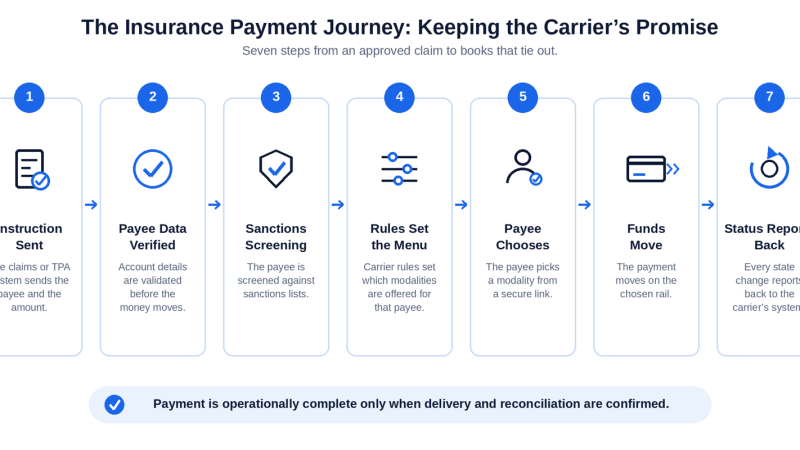
The mechanism is straightforward. The carrier’s rules set which methods a given payee is offered, based on line of business and payee type. The payee chooses among those from a secure link, with any applicable fee visible at that moment. Nobody guesses. The rules keep finance and compliance in control of what’s permitted; the payee supplies the one piece of information the carrier never had, which is what they can actually receive.
The status call is the leading indicator. If your claims operation treats “where’s my payment?” as a fixed volume to be staffed, it’s worth asking what proportion of those calls trace back to a payment that went out in a form the payee didn’t want, or on a timeline they couldn’t see. Both causes are addressable. Staffing the call is not the same as removing the reason for it.
The dark stretch, and what it costs finance
Between the moment a payment is issued and the moment anyone can confirm it landed, most operations can’t see anything. That interval is where reconciliation cost is created.
If status doesn’t report back automatically, finance reconstructs it later: pull a bank statement, match against the claims system, chase the differences. The cost is staff hours, and the hours scale with volume rather than with problems — you pay them whether or not anything went wrong.
Closed-loop reporting removes the reconstruction. Every state a payment passes through reports back to the payer’s ledger automatically over signed, idempotent webhooks: issued, delivered, claimed, cashed, returned, unclaimed. Signed means the receiving system can verify the message came from the payment system. Idempotent means a retried message won’t double-post. The books stay current as a property of the workflow, so month-end stops being a reconstruction exercise.
For a finance leader the test is simple: on the day a payment is issued, can your ledger tell you what state it’s in without anyone making a phone call? If not, the reconciliation cost is already in your run rate. It’s just recorded as headcount.
The tail: exceptions, stale-dated funds, and escheatment
The longest-dated cost in outbound payments is the one nobody books until it’s overdue.
Funds that are issued but never claimed don’t stay in limbo indefinitely. Under state unclaimed-property regimes, unclaimed funds generally become reportable and remittable to the state once a dormancy period passes.5 Dormancy periods and filing rules vary by jurisdiction, and the obligations sit with your compliance and legal teams — this is operational tracking, not legal advice. But the operational job is well within finance’s control: see the unclaimed payment early enough to do something about it.
That depends entirely on whether unclaimed is a reported event or an absence. When a payment aging toward stale-dated status surfaces as a status change, someone can act — contact the payee, stop the original, reissue on a method the payee actually chose. When it surfaces as a balance that won’t reconcile, the cheap window has usually closed.
The same logic applies to every other exception: a returned ACH, a declined card, an expired virtual card, an undelivered notification. Each is recoverable at low cost if it announces itself, and expensive if someone finds it during a reconciliation weeks later.
Build your own number
Published benchmarks are useful for orientation and useless for a business case, because your mix, your payee population, your fee configuration, and your existing bank fees are specific to you. Here’s how to build a figure you can defend internally. Pull one quarter of outbound payments.
| Line | What to pull | Why it matters |
|---|---|---|
| 1. Volume by method | Count of payments by modality | The mix, not the average, drives the total |
| 2. Loaded cost per method | Provider fees plus personnel, IT, and print/postage | Matches AFP’s methodology; fees alone understate it |
| 3. Fee incidence | Per modality, whether you participate and on what basis — percentage, fixed amount, or not at all | Changes both your direct cost and the mix in line 1 |
| 4. First-attempt success rate | Payments that landed without intervention, by method | The single highest-leverage number in the model |
| 5. Reissue cost | Reissue count × (stop-pay fee + staff time + second issuance + second reconciliation) | The tail that is usually spread across three systems |
| 6. Status contact cost | Payment-status contacts × loaded handling cost | Ask separately how many reached an adjuster rather than a payments team |
| 7. Reconciliation hours | Staff hours spent matching payments to the claim record | Scales with volume, not with problems |
| 8. Aging unclaimed balances | Issued-but-unclaimed funds by age bucket | Your escheatment exposure, and your early-warning window |
| 9. Fraud and recovery | Losses, investigation time, and controls spend | The job is sizing this, not eliminating the rail |
Lines 3 through 8 are the ones most operations have never totaled. They’re also where the recoverable money is. If lines 1 and 2 are the only ones you can produce today, that itself is a finding.
The interaction worth modeling explicitly is line 3 against line 1. Change who pays and the mix moves; move the mix and lines 4 through 9 move with it. A model that adjusts fee incidence without re-forecasting the mix will tell you pass-through is free, and it isn’t.
Note on our figures
We publish three numbers from carrier rollouts: roughly six days off the claim cycle, about 92 percent of payments cleared same day, and a reissue rate down by about 70 percent. These are carrier-reported, drawn from the first 90 days after rollout, and we label them representative rather than guaranteed. Results depend on your line of business, your payee mix, your fee configuration, and what you pay with today. They are not research, and they are deliberately not in the reference list below.
See it run on a sample claim
A 30-minute walkthrough with a CSM, using your line of business and your claims system: the adjuster view, the payee view, and the webhook trail end to end.
Schedule a walkthrough · Read: how insurance carriers pay claimants after approval · Read: payment orchestration in insurance
Frequently asked questions
What does it actually cost to issue a claim payment?
AFP’s benchmark puts the median cost of issuing a paper check at $2.01 to $4.00, built from bank fees plus internal costs including personnel, fraud liability, and reissues.1,2 Your own figure depends on your modality mix, your fee configuration, and your first-attempt success rate, which is why the model above builds it from your own volumes rather than applying a benchmark.
Who pays the payment fee, the carrier or the payee?
The postal check is always billed to the carrier — there is no setting that charges a payee for a mailed check. Every other modality is splittable: the carrier can participate in the fee on a percentage basis or as a fixed dollar amount, or not at all, in which case the payee absorbs it in full. Full payee absorption is the common configuration. The payee sees the fee for each method before selecting, then sees the gross amount, the fee, and the net they will receive, and has to accept that figure to proceed — or back out to another modality, or to the postal check at no cost. Declining to participate isn’t automatically the cheaper position.
Isn’t the answer just to move everything off checks?
No, and any model assuming full conversion will miss. AFP found 86 percent of organizations still issue checks and 92 percent still accept them, with the share actively transitioning having declined since 2015.2 In claims, some payees have no bank account and some settlements require a physical instrument. The goal is to stop defaulting to a check for payees who would have chosen otherwise, and to operate the checks you do issue with proper controls.
How does letting the payee choose reduce cost?
It raises the first-attempt success rate. A payment that arrives in a usable form doesn’t generate a status call, a stop-pay, a reissue, or a second reconciliation pass. Reissues are where disbursement cost concentrates, so choice functions as a cost control rather than only as a service improvement.
What is closed-loop reconciliation, in finance terms?
Every state change on a payment reports back to your ledger automatically rather than being reconstructed later from a bank statement. The saving is the reconciliation labor that scales with volume regardless of whether anything went wrong.
Where does escheatment exposure come from?
From issued funds that are never claimed. Under state unclaimed-property regimes these generally become reportable and remittable once a dormancy period passes, with periods and filing rules varying by jurisdiction.5 The operational question is whether an unclaimed payment surfaces as a reported event in time to act on it, or as a balance discrepancy after the window has closed.
What should we ask a disbursement provider to evidence?
Sanctions screening on every payment rather than at onboarding,6 account validation before submission, positive pay on checks, 1099 handling, retrievable per-payment state history, and certifications with the report attached rather than a badge. SOC 2 Type II is the baseline to confirm. Treat any claimed certification as something to evidence, not accept — including ours.
References
- Association for Financial Professionals, 2022 AFP Payments Cost Benchmarking Survey (underwritten by Corpay; based on approximately 350 practitioners) — median cost to issue a paper check $2.01–$4.00. financialprofessionals.org
- Association for Financial Professionals, 2022 AFP Payments Cost Benchmarking Survey, comprehensive results — methodology covering external and internal costs including personnel, IT, fraud liability, account validation, and voids and reissues; 86% of organizations use checks for outgoing payments; 73% currently transitioning from checks, down from 79% in 2015. AFP (PDF)
- Association for Financial Professionals, 2026 AFP Payments Fraud and Control Survey Report, released 14 April 2026, based on 465 respondents; findings cover 2025 activity. financialprofessionals.org
- Financial Crimes Enforcement Network, FinCEN Alert on Nationwide Surge in Mail Theft-Related Check Fraud Schemes Targeting the US Mail, 27 February 2023. fincen.gov
- National Association of Unclaimed Property Administrators, Reporting Overview. unclaimed.org
- US Department of the Treasury, Office of Foreign Assets Control, Specially Designated Nationals and the SDN List. ofac.treasury.gov
Nothing in this article is legal, tax, or regulatory advice. Escheatment, unclaimed property, 1099, and OFAC obligations vary and belong to your compliance and legal teams.