How Insurance Carriers Pay Claimants After a Claim Is Approved
Keeping the carrier’s promise: the outbound side of the claim, from an approved amount to books that tie out.
The bottom line
Once a claim is approved, the carrier’s rules set which payment modalities a payee is offered, and the payee chooses among them. That one distinction is what separates a payment that arrives as expected from a mailed check nobody asked for. Add screening on every payment and state changes that report back in real time, and reconciliation stops being a monthly chase.
Most claims teams treat “where’s my payment?” as a fact of life, a steady hum of calls that comes with paying people. It isn’t. Most of those calls trace back to the same two things: a payment that went out in a form the payee didn’t want, or on a timeline they couldn’t see.
This guide covers the outbound side of the claim, after approval: how a carrier, TPA, or MGA turns an approved amount into money in the payee’s hands, and how the books tie out afterward. It is not about deciding claims, coverage, or adjudication. A payout is a promise the carrier already made. The work is to keep that promise quickly, in the form the person actually wants, and to prove it was kept.
What happens after a claim is approved?
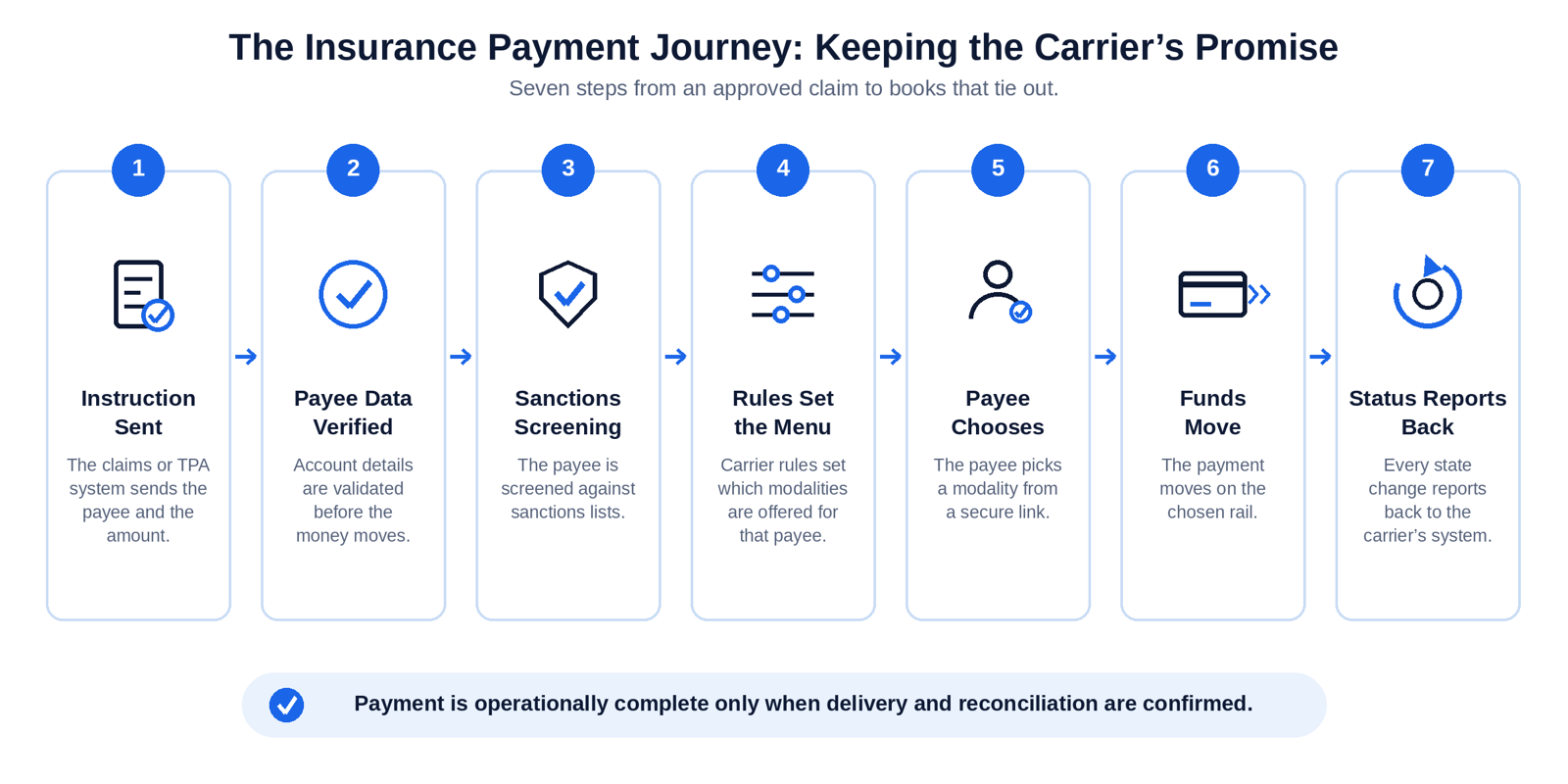
Once a claim is approved, the payment runs through a short, ordered sequence:
- The claims or TPA system sends the payee and the amount.
- The payee data is verified.
- The payee is screened against sanctions lists.
- The carrier’s rules set which payment modalities are offered for that payee.
- The payee chooses one from a secure link.
- The funds move on the chosen rail.
- Every state change reports back to the carrier’s system.
Steps 2 and 3 are where most of the downstream cost is decided. Verifying account details and screening before the money moves is cheap. Discovering a bad account number after an ACH return, or a sanctions hit after settlement, is not.
The distinction that matters
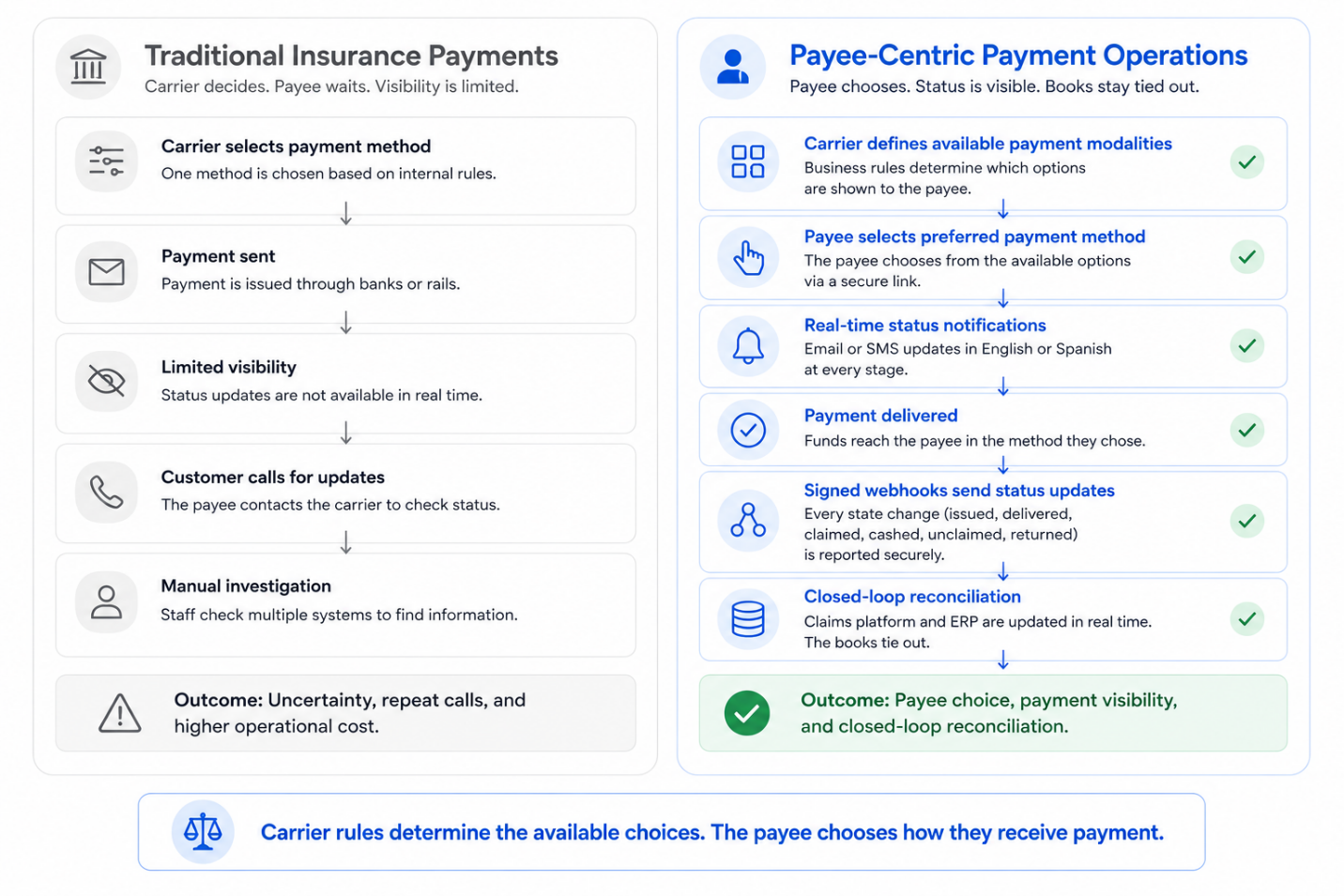
The carrier’s rules set the menu. The payee makes the choice.
That distinction does more work than it looks like it does. When a payment engine picks one rail by rule and routes the transaction, the payee never enters the decision — and that is where the “where’s my payment?” call is born. The difference is not whether rules are involved. Rules are involved in both models. The difference is whether the rules select the options or select the outcome. If you want the wider argument for treating that coordination as its own layer, we cover it in our piece on payment orchestration in insurance.
What are the eight ways a claimant can be paid?
A payee picks their payment modality from the options the carrier has enabled for that line of business. The eight modalities are:
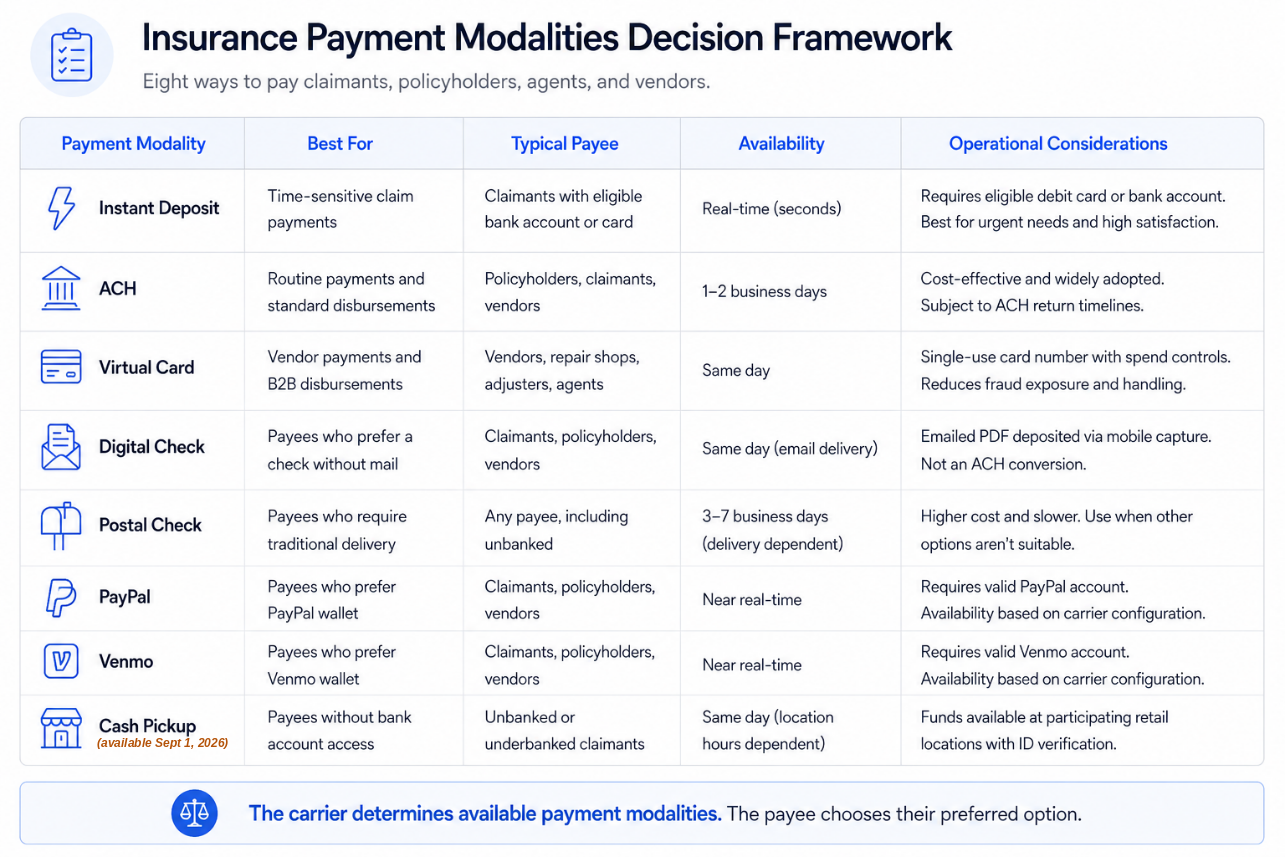
| Payment modality | How the payee receives it | Suited to |
|---|---|---|
| Instant deposit | Real-time push to an eligible debit card or account | Time-sensitive claim payouts |
| Virtual card | A unique, single-payee card number issued to a secure link | Vendor payments, agent commissions |
| ACH | Direct credit to a bank account | Routine claim payouts and premium refunds |
| Digital check | An emailed PDF the payee deposits by mobile capture | Payees who want a check without the mail |
| Postal check | A printed check delivered by mail | Payees who prefer or require paper delivery |
| PayPal | Credit to the payee’s PayPal account | Payees who prefer a wallet |
| Venmo | Credit to the payee’s Venmo account | Payees who prefer a wallet |
| Cash pickup (available 1 September 2026) | Cash collected at a retail location | Unbanked or underbanked payees |
Don’t confuse these
A digital check is an emailed PDF the payee deposits by mobile capture. It is not an e-check or an ACH conversion. The two settle differently and reconcile differently.
Offering a modality is not the same as defaulting to it. When the payee chooses, the carrier stops guessing which method a given person wanted, and stops paying for the reissue when the guess is wrong.
Why “where’s my payment?” happens, and what stops it
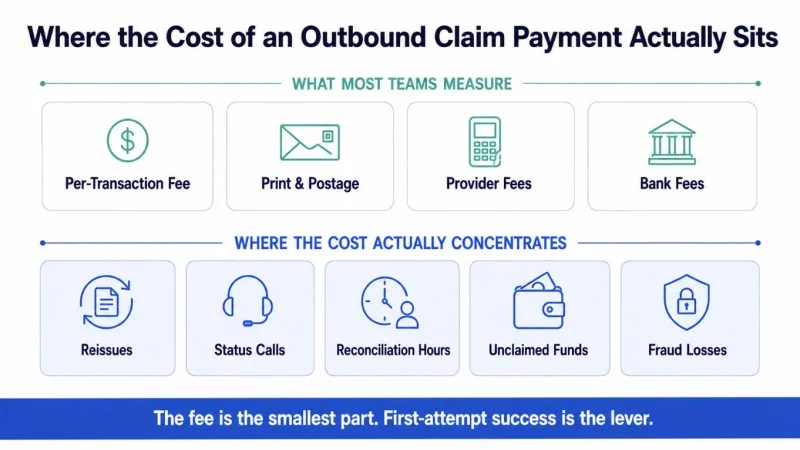
The status call is a symptom, not a volume to be managed. It happens for two reasons: the payment went out in a form the payee did not want, or it went out on a timeline the payee could not watch. A mailed check to someone who wanted an instant deposit produces both problems at once.
Closing that gap means two things. Let the payee choose the form, so the payment arrives the way they expected. Then give them a status they can watch, in language they can read. When payee questions do come in, they can be handled on the carrier’s behalf rather than in the carrier’s own call center. The call does not get easier to handle. It has less reason to happen.
How does closed-loop reconciliation actually close?
Reconciliation lags when the payment system goes dark after the money leaves. Closed-loop reconciliation removes that gap by reporting every state change back to the carrier’s ledger over signed, idempotent webhooks: issued, delivered, claimed, cashed, returned, and unclaimed. Signed means the carrier can trust the message came from the payment system. Idempotent means a retried message is safe and will not double-post.
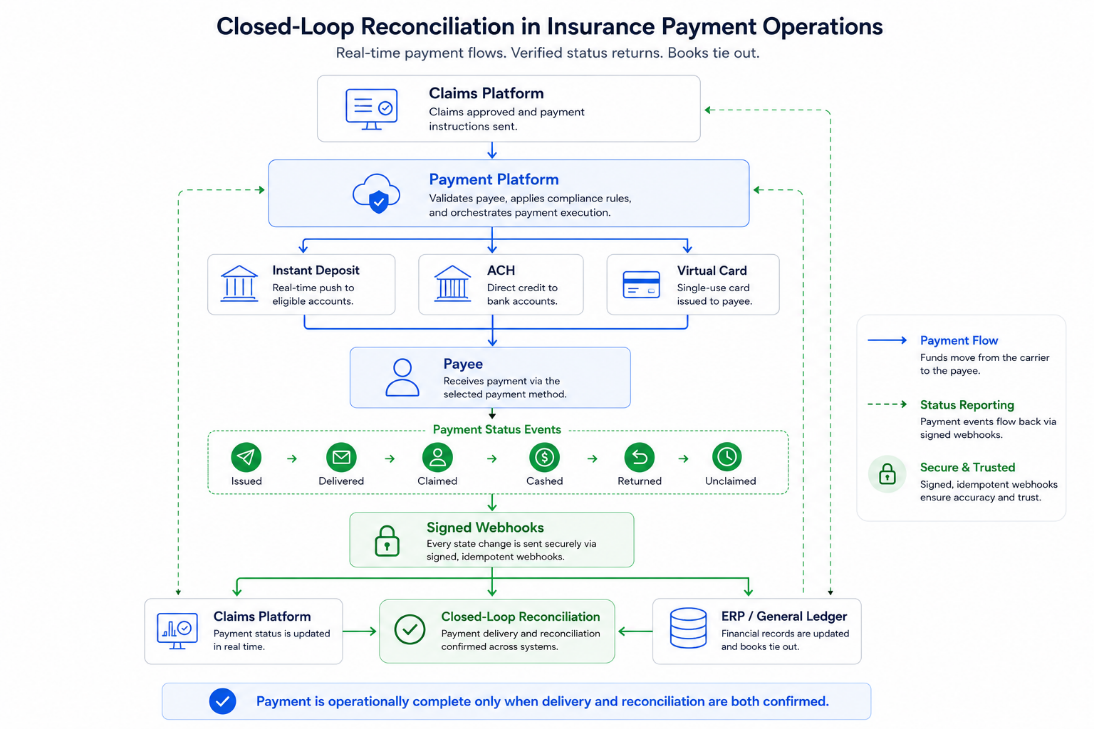
The operational point worth pausing on is that unclaimed is itself a reported event. When a payment aging toward stale-dated status arrives as a webhook rather than as a silence, the carrier can act on it, reissue it, or track it against state escheatment rules before it becomes an unclaimed-property problem. Faster reconciliation is the obvious benefit. The earlier warning is the more valuable one.
What failure modes are carriers already paying for?
Even with the right rails, the expensive breaks happen after the payment leaves. Each of these is addressable with controls that already exist.
- Check fraud. Checks remain the payment method most frequently hit by fraud. In the 2026 AFP Payments Fraud and Control Survey, drawn from 465 corporate practitioners, 58 percent of organizations reported check fraud in 2025 — ahead of ACH debits at 30 percent and wire transfers at 25 percent.1 Much of the exposure runs through the mail. In February 2023, FinCEN, working with the US Postal Inspection Service, issued an alert on a nationwide surge in mail theft-related check fraud, reporting that check-fraud suspicious activity reports rose from over 350,000 in 2021 to over 680,000 in 2022.2 Positive pay and single-payee virtual card numbers both reduce the surface a forged or altered check exposes.
- Wrong or returned payments. Account verification before the payment leaves catches bad account details up front, rather than after an ACH return and a manual reissue.
- Stop-pays and reissues. When a check goes stale or a loss draft never arrives, the recovery is usually the expensive part: a form, a call to the bank, and a second wait for the payee. Stopping the original and reissuing on whichever modality the payee prefers should be one action inside the workflow rather than a multi-step process across three teams.
- Stale-dated checks and escheatment. A reported unclaimed state lets a carrier act before funds age into state unclaimed-property handling, where dormancy periods and filing rules vary by jurisdiction. This is operational tracking, not legal advice; the obligations themselves belong to your compliance and legal teams.
- Multi-party payments. One claim can owe three parties at once. A claimant on instant deposit, a lienholder on ACH, and a body shop on a virtual card can settle from a single instruction, each leg tracked independently, and still tie out to one claim record.
How instant rails change the order of the work
For time-sensitive payouts it helps to know the plumbing. FedNow is operated by the Federal Reserve, launched in 2023, and runs in real time around the clock every day of the year.3 The RTP network is operated by The Clearing House, launched in 2017, also runs 24/7, and is credit-push only, meaning funds are pushed and cannot be pulled.4
Irrevocable is the word that matters operationally. On the RTP network, settlement is final: a sending institution cannot unilaterally recall a payment once submitted. The network provides a message to request the return of funds, but the receiving side is not obliged to send them back.4 In practice that moves the control step rather than removing it. Verification has to happen before the payment leaves, not after.
How should a carrier evaluate a disbursement partner?
Use this as a working checklist. It applies to any vendor in the category, including us.
- Choice. Does the payee choose across payment modalities, or does an engine pick one for them?
- Reporting. Do state changes report back over signed, idempotent webhooks, or arrive in a periodic file?
- Reconciliation. Does it close automatically to the claim record, or does finance still match by hand?
- Payee support. Is it handled for you, in the languages your payees actually speak, or does it land in your call center?
- Controls. Are sanctions screening, positive pay, and 1099-ready reporting built in?
- Certifications. Which are actually held, and can you see the report rather than a badge? SOC 2 Type II is the baseline to confirm. Ask separately about PCI DSS scope, and treat any claimed certification as something to evidence, not accept.
- Integration model. API, batch file, or portal? A REST API with webhooks lets status flow back automatically; a batch-only model puts you back on a periodic file.
- Ledger separation and ownership. Are funds held in segregated ledgers, and is your CSM a named person or a shared queue?
- Cost. What does the carrier pay by default, and what changes that?
The questions are deliberately answerable in a demo. Any of them that gets a roadmap answer rather than a live one is worth pressing on.
Where DisburseCloud fits
DisburseCloud is the outbound-payment side of the Tranzpay platform. Tranzpay collects premium coming in; DisburseCloud pays everything going out, across claims payments, premium refunds, and vendor payments. We do not decide the claim. We keep the promise the carrier already made, in the modality the payee chose, with every state change reported back so the books tie out.
Specifically, against the checklist above: every payee is screened against OFAC on every payment rather than once at onboarding. The payee chooses from a single secure, OTP-gated link. Status notifications go out by email or SMS in English or Spanish. When a payee has a question, US-based agents handle it on the carrier’s behalf. Positive pay and 1099-ready reporting are both in the platform. SOC 2 Type II is the certification to ask us to evidence, and we will send the report rather than the badge.
Note on our figures
We publish three numbers from carrier rollouts: roughly six days off the claim cycle, about 92 percent of payments cleared same day, and a reissue rate down by about 70 percent. These are carrier-reported, drawn from the first 90 days after rollout across our earliest carrier deployments, and we label them representative rather than guaranteed. Results depend on your line of business, your payee mix, and what you pay with today. We are not citing them as research, and they are not in the reference list below with the survey and central bank sources.
See it run on a sample claim
A 30-minute walkthrough with a CSM, using your line of business and your claims system: the adjuster view, the payee view, and the webhook trail end to end.
Schedule a walkthrough · Read: what payment orchestration means in insurance
Frequently asked questions
Does the carrier or the claimant choose the payment method?
The carrier’s rules decide which payment modalities a given payee is offered, based on the line of business and the payee type. The payee then chooses among them from a secure link. Rules set the menu; the payee makes the choice.
How long does a claim payment take after approval?
It depends on the modality the payee picks, not on the approval. Instant deposit and virtual card typically reach the payee in minutes. ACH usually takes one to two business days. A postal check takes five to seven business days, including mail time.
Is a digital check the same as an ACH e-check?
No. A digital check is an emailed PDF the payee deposits by mobile capture. An e-check or ACH conversion moves through the ACH network. They settle differently and reconcile differently, so the distinction matters when you are mapping payment states to your ledger.
What is closed-loop reconciliation in insurance payments?
It is the practice of reporting every payment state change back to the carrier’s ledger in real time, typically over signed webhooks, so the carrier’s books and the payment system agree without a manual match or a phone call. Issued, delivered, claimed, cashed, returned, and unclaimed are all reported events.
How do carriers pay claimants who do not have a bank account?
Unbanked and underbanked payees can be paid without an account through a virtual card, a mailed check, or cash pickup at a retail location (available from 1 September 2026). Offering the choice matters here more than anywhere else, because a default that assumes a bank account fails silently for exactly the people least able to absorb the delay.
Can one claim pay several parties at once?
Yes. A single approved instruction can settle multiple legs, for example a claimant, a lienholder, and a repair vendor, each choosing their own modality and each tracked independently, while still reconciling back to one claim record.
References
- Association for Financial Professionals, 2026 AFP Payments Fraud and Control Survey Report, released 14 April 2026, based on 465 respondents; findings cover 2025 activity. https://www.prnewswire.com/news-releases/over-75-of-us-firms-experienced-payments-fraud-in-2025-while-ai-adoption-for-fraud-mitigation-lags-302738857.html
- Financial Crimes Enforcement Network, FinCEN Alert on Nationwide Surge in Mail Theft-Related Check Fraud Schemes Targeting the US Mail, 27 February 2023. https://www.fincen.gov/news/news-releases/fincen-alert-nationwide-surge-mail-theft-related-check-fraud-schemes-targeting
- Board of Governors of the Federal Reserve System, About the FedNow Service. https://www.federalreserve.gov/paymentsystems/fednow_about.htm
- The Clearing House, RTP Network for Financial Institutions. https://www.theclearinghouse.org/payment-systems/rtp/institution
Nothing in this article is legal, tax, or regulatory advice. Escheatment, unclaimed property, 1099, and OFAC obligations vary and belong to your compliance and legal teams.