What Is a Fintech Claims Platform? The Three Layers, and Which One Leaks

The term covers three different layers of work. Two are already well served. The third is where the cost and the exposure concentrate.
The bottom line
“Fintech claims platform” is a category label doing three jobs at once, which is why buyers comparing two vendors under that heading often find they aren’t comparing the same thing at all.
The term gets applied to systems that take in a claim, to systems that decide it, and to systems that pay it. Those are three different disciplines with three different vendor landscapes and three very different maturity levels. A buyer who treats them as one purchase ends up either replacing a system that was working or, more commonly, solving the first two problems and leaving the third alone.
This piece separates the layers, says plainly which ones are already handled well, and makes the case that the third is where the recoverable money sits.
What the term actually covers
Strip the marketing off the category and there are three layers between a loss and a paid claimant.
Layer 1 — Intake. First notice of loss, documentation capture, claimant portals, mobile photo submission, third-party data enrichment. Getting the claim and its evidence into a system cleanly.
Layer 2 — Adjudication. Coverage determination, reserving, adjuster assignment and workflow, fraud investigation, approval authority. Deciding whether the claim is payable and for how much.
Layer 3 — Disbursement. Everything after approval: getting the approved amount to the payee in a form they can use, tracking it until it lands, handling what happens when it doesn’t, and closing the books against the claim record.
Most vendors marketed as fintech claims platforms operate in one or two of these. Very few operate in all three, and the ones claiming to usually mean they have an API into someone else’s layer. The useful question in a buying process is not “is this a fintech claims platform” but “which layer does this replace, and which layer is it talking to.”
The two layers that are already well served
This is the part most category content skips, because it isn’t a sales argument.
Intake and adjudication are mature. Established claims and policy administration systems — Guidewire, Duck Creek, Majesco, and the modern core platforms alongside them — have spent two decades on workflow, coverage logic, reserving, adjuster tooling, and audit. They are good at it. A carrier with a functioning claims system and a documented adjudication process does not have a layer 1 or layer 2 problem worth a platform migration.
Fraud is instructive here, because the headline number belongs to this layer and gets borrowed by the next one. The Coalition Against Insurance Fraud’s study — the first comprehensive US estimate in more than 25 years — put the annual economic impact of insurance fraud at $308.6 billion, spread across life, Medicare and Medicaid, property and casualty, health, premium, and workers’ compensation lines.1 That is overwhelmingly claim fraud: false claims, inflated claims, premium fraud. It’s a layer 2 problem, and it’s the problem SIU teams and adjudication systems exist to attack.
Don’t confuse these
Claim fraud is not payment fraud. A platform that cites the $308.6 billion figure while selling you a disbursement product is conflating two problems to make one of them look bigger. Worth noticing when it happens.
The third layer, and why it leaks
Payment fraud is a smaller number with a sharper edge, and it sits squarely at the disbursement layer.
Checks are the payment method most frequently hit. In the 2026 AFP Payments Fraud and Control Survey, drawn from 465 corporate practitioners, 58 percent of organizations reported check fraud in 2025, ahead of ACH debits at 30 percent and wire transfers at 25 percent.2 Much of that exposure runs through the mail: in February 2023, FinCEN, working with the US Postal Service, reported that check-fraud suspicious activity reports rose from over 350,000 in 2021 to over 680,000 in 2022.3
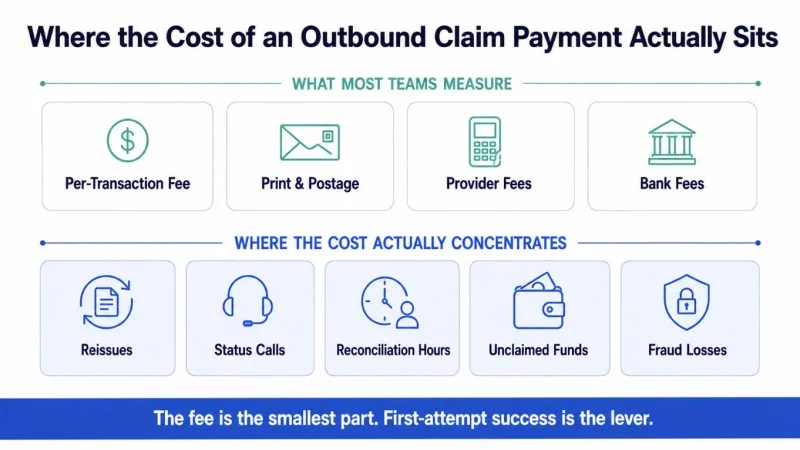
Cost leaks here too, and not where buyers look for it. AFP’s median cost to issue a paper check is $2.01 to $4.00 — a figure built from bank fees plus internal costs including personnel, IT, fraud liability, account validation, and voids and reissues.4 That last item is the one that matters. A payment that lands correctly the first time costs what the benchmark says. A payment that doesn’t costs the original amount plus a stop-pay, the staff time to place it, a payee contact, a second issuance, and a second pass through reconciliation.
Three costs that are rarely totaled as one number
They are recorded in three different places, which is why they are almost never added up.
- Reissues. A single one can cost more than twenty first-attempt payments.
- The dark stretch. The interval between issuance and confirmation, during which reconciliation is done by reconstruction from a bank statement rather than by reading a status. That labor scales with volume whether or not anything went wrong.
- The escheatment tail. Issued funds never claimed. Under state unclaimed-property regimes these generally become reportable and remittable once a dormancy period passes, with periods and filing rules varying by jurisdiction.5
None of the three is a claims-system problem. A perfectly adjudicated claim can generate all of them.
What “disbursement-native” should mean
The phrase gets used to mean “the payment button is inside the claims screen.” That’s integration, and it’s table stakes rather than an architecture.
What actually distinguishes the layer is four properties.
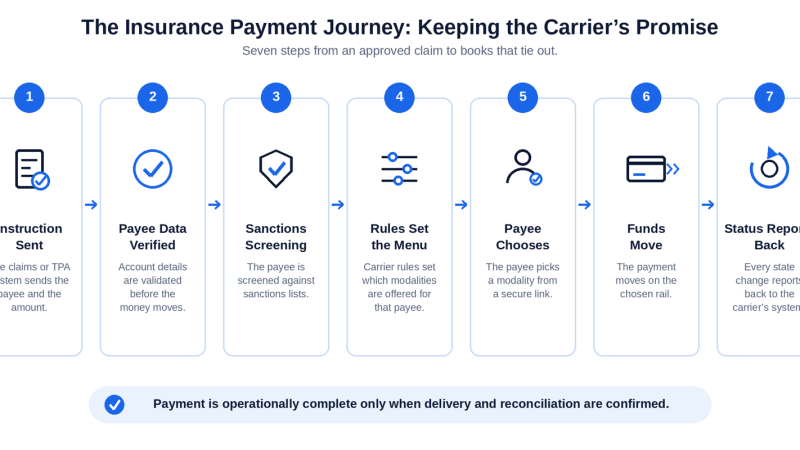
The payee picks the method. The carrier’s rules set which methods a given payee is offered, based on line of business and payee type. The payee chooses among those. This is the single largest lever on first-attempt success, because a payment that arrives in a form the person can actually use doesn’t generate a call, a stop-pay, a reissue, or a second reconciliation. Choice is a cost control before it’s a service improvement.
A no-cost option always exists. A mailed check that the payee is never charged for is what makes every other option a genuine choice rather than a toll. It’s also why checks are permanent infrastructure at this layer rather than a legacy format to be migrated off — a point worth holding onto, given AFP found 86 percent of organizations still use checks for outgoing payments and the share actively transitioning away has fallen since 2015, from 79 percent to 73 percent.4
Every state change reports back. Issued, delivered, claimed, cashed, returned, unclaimed — reported to the payer’s ledger automatically over signed, idempotent webhooks rather than assembled from a periodic file. Signed means the receiving system can verify the message’s origin. Idempotent means a retry won’t double-post.
Exceptions announce themselves. A returned ACH, a declined card, an expired virtual card, an undelivered notification, a check aging toward stale-dated — each surfaces as an event, early, while a fix is still cheap. The alternative is finding it during a reconciliation weeks later, which is the same problem at ten times the cost.
If a vendor has the first two, the payee experience is right. If it has all four, finance stops chasing.
Controls that belong at the payment layer
Compliance at layer 3 is narrower than category marketing suggests, and being precise about the boundary is worth more to a buyer than a longer list.
What belongs here:
- Sanctions screening on every payment. Every payee screened against the OFAC Specially Designated Nationals list at payment creation, not inherited from a check run at onboarding months earlier.6
- Account validation before submission, so a bad account number surfaces before the money moves rather than as a return code afterward.
- Positive pay through the issuing bank on checks, so an altered or forged item is detectable before it clears.
- 1099-ready reporting assembled as a property of disbursement rather than reconstructed at year end.
- Retrievable per-payment state history with timestamps, without a support request.
- Unclaimed-property tracking — surfacing an unclaimed payment early enough to act on it.
What does not belong here, and should raise a question if a disbursement vendor claims it: claim-level fraud scoring, eligibility decisioning, and the unclaimed-property filing itself. Dormancy periods and filing obligations vary by jurisdiction and belong to your compliance and legal teams; a payment platform’s job is to make the exposure visible in time, not to assume the obligation.
On certifications, the only useful standard is evidence. Ask which are held, ask for the report rather than the badge, and treat any claim as something to be substantiated. SOC 2 Type II is the baseline to confirm — and that applies to us as much as anyone.
How to evaluate, layer by layer
Run these separately. A vendor strong at one layer answering confidently for another is the thing to catch.
| Layer | The questions that separate real from marketed |
|---|---|
| Intake | Does it fit the channels your claimants actually use? Does it hand off cleanly to whatever decides the claim? |
| Adjudication | Whose coverage logic, whose reserving, whose approval authority? Is your existing system doing this adequately already? |
| Disbursement | Does the payee choose, or does an engine pick? Is there always a no-cost option? Do state changes report back over signed webhooks, or arrive in a file? Does reconciliation close to the claim record automatically? Who answers a payee’s status question? Are sanctions screening, account validation, positive pay, and 1099 reporting built in? Which certifications, with the report attached? |
The disbursement column is longer because it’s the one buyers arrive with the fewest prepared questions for. Every item in it is answerable in a live demo. Any that gets a roadmap answer instead is worth pressing on.
Where DisburseCloud fits
DisburseCloud operates at layer 3 only. It is the outbound-payment side of the Tranzpay platform: Tranzpay collects premium coming in, DisburseCloud pays everything going out, across claims payments, premium refunds, and vendor payments.
We do not take in claims and we do not decide them. There is no intake portal, no coverage logic, no adjuster workflow, and no claim-level fraud model, because those belong to the system you already have. We start once your system has approved a payment.
At that point: the payee chooses from the methods your rules permit, via a secure link, with any applicable fee shown before they choose. The mailed check is always available to them at no cost. Every payee is screened against the OFAC SDN list on every payment. Every state change reports back over signed, idempotent webhooks. Exceptions surface on their own, and a stop-and-reissue onto a different method is one action rather than a process across three teams. Payee status questions go to our own US-based agents, in English or Spanish, rather than to your call center. SOC 2 Type II is the certification to ask us to evidence, and we will send the report.
Note on our figures
We publish three numbers from carrier rollouts: roughly six days off the claim cycle, about 92 percent of payments cleared same day, and a reissue rate down by about 70 percent. These are carrier-reported, drawn from the first 90 days after rollout, and we label them representative rather than guaranteed. Results depend on your line of business, your payee mix, and what you pay with today. They are not research, and they are deliberately not in the reference list below.
See it run on a sample claim
A 30-minute walkthrough with a CSM, using your line of business and your claims system: the adjuster view, the payee view, and the webhook trail end to end.
Schedule a walkthrough · Read: how insurance carriers pay claimants after approval · Read: what payment orchestration means in insurance · Read: what an outbound claim payment actually costs
Frequently asked questions
What is a fintech claims platform?
It’s a loose label covering three different layers of work: intake (getting the claim and its documentation in), adjudication (deciding coverage and amount), and disbursement (getting the approved amount to the payee and reconciling it). Vendors marketed under the term usually operate in one or two of these. The useful question in a buying process is which layer a given platform replaces and which layer it integrates with.
How is a fintech claims platform different from a claims management system?
A claims management system handles intake and adjudication — workflow, coverage determination, reserving, adjuster assignment, reporting. Most do not move money beyond handing off a payment file. A disbursement platform operates after approval: payee choice of method, execution across rails, status tracking, exception handling, and reconciliation back to the claim record. They’re complements, not substitutes.
Do we need to replace our claims system to modernize claim payments?
No, and that’s the practical point of separating the layers. If intake and adjudication are working, the disbursement layer can be addressed on its own through an API and webhooks, without touching the system of record.
Where does the cost actually sit in claim payments?
Less in the per-transaction fee than in what happens after the money leaves. AFP’s benchmark for issuing a paper check — $2.01 to $4.00 — is itself built from bank fees plus internal costs including personnel, fraud liability, and voids and reissues.4 Reissues, the reconciliation labor created by an unreported payment status, and unclaimed funds aging toward escheatment are usually recorded in three different places and rarely totaled as one number.
Isn’t insurance fraud the main reason to modernize claims?
Fraud is the main reason to invest in adjudication. The Coalition Against Insurance Fraud’s estimate of $308.6 billion in annual economic impact is predominantly claim fraud across all lines.1 The disbursement layer has a different and narrower fraud problem — payment fraud, where checks are the most frequently hit method at 58 percent of organizations in 2025.2 Conflating the two makes a payment product look like a fraud product.
How do carriers pay claimants who don’t have a bank account?
Without an account, a payee can be paid by mailed check, by virtual card, or through cash pickup at a retail location. Offering the choice matters more here than anywhere else, because a default assuming a bank account fails silently for exactly the people least able to absorb a delay.
What should a disbursement platform be able to evidence?
Sanctions screening on every payment rather than at onboarding, account validation before submission, positive pay on checks, 1099-ready reporting, retrievable per-payment state history, and certifications with the report attached rather than a badge. SOC 2 Type II is the baseline to confirm.
References
- Coalition Against Insurance Fraud, The Impact of Insurance Fraud on the U.S. Economy, 2022 — $308.6 billion annual economic impact across all lines of insurance. insurancefraud.org
- Association for Financial Professionals, 2026 AFP Payments Fraud and Control Survey Report, released 14 April 2026, based on 465 respondents; findings cover 2025 activity. financialprofessionals.org
- Financial Crimes Enforcement Network, FinCEN Alert on Nationwide Surge in Mail Theft-Related Check Fraud Schemes Targeting the US Mail, 27 February 2023. fincen.gov
- Association for Financial Professionals, 2022 AFP Payments Cost Benchmarking Survey (underwritten by Corpay; approximately 350 practitioners) — median cost to issue a paper check $2.01–$4.00; methodology covering external and internal costs including personnel, IT, fraud liability, account validation, and voids and reissues; 86% of organizations use checks for outgoing payments; 73% currently transitioning from checks, down from 79% in 2015. AFP (PDF)
- National Association of Unclaimed Property Administrators, Reporting Overview. unclaimed.org
- US Department of the Treasury, Office of Foreign Assets Control, Specially Designated Nationals and the SDN List. ofac.treasury.gov
Nothing in this article is legal, tax, or regulatory advice. Escheatment, unclaimed property, 1099, and OFAC obligations vary and belong to your compliance and legal teams.