Payment Orchestration in Insurance: Why Moving the Money Was Never the Hard Part
The outbound side of a claim, after approval: what orchestration means when the money is going out rather than coming in.
The bottom line
Payment orchestration in insurance is not a faster rail. Moving money between two accounts has been fast and reliable for years. Orchestration is the coordination around the transfer: the payee choosing how they are paid, compliance controls applied to every payment, every state change reporting back in real time, and books that agree without a chase. Get that layer right and “where’s my payment?” stops being a fact of life.
Ask an insurance operation what payment orchestration means and most people describe a rail: ACH instead of a paper check, a faster transfer instead of a slow one. That is real progress, and it solves the easy problem.
What is actually hard, and what orchestration is for, is everything that has to happen around the transfer. Letting the payee choose how they are paid. Keeping compliance current as the payment moves. Reporting every state change back in real time. Reconciling the books without a chase.
This piece is about the outbound side only: what happens after a claim is approved and the money has to go out. Not the decision, not coverage, not adjudication. The promise has already been made by the time any of this starts.
What payment orchestration means in insurance
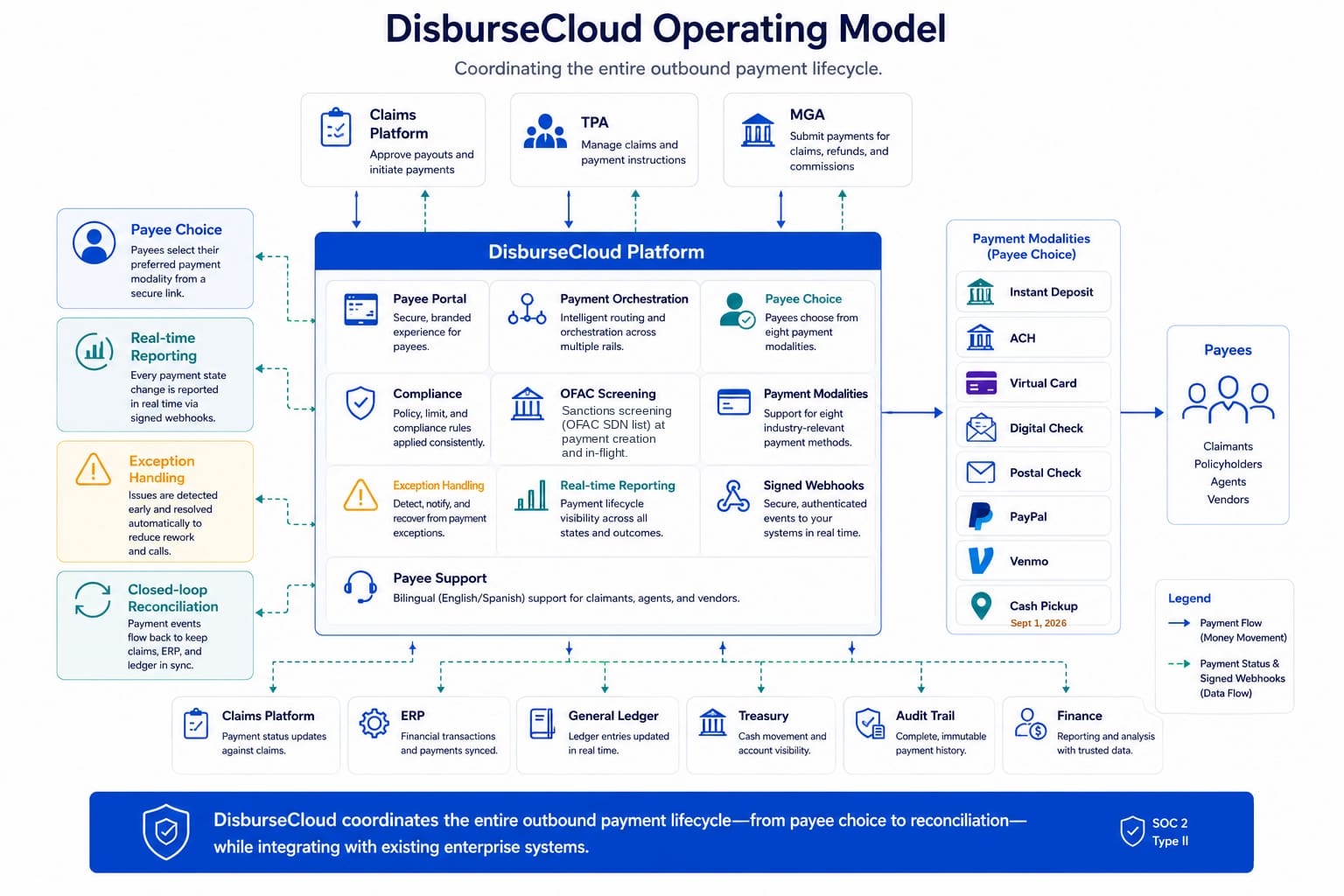
Payment orchestration in insurance is the coordination layer around an outbound payment: deciding what instruction to send based on the payee’s chosen method, applying controls to the payment, tracking its state after it leaves, and reporting each change back to the payer’s system. It is distinct from the rail that carries the money and from the processor that executes the transfer.
Most explanations of payment orchestration online are written for e-commerce: a platform that sits in front of checkout and routes card transactions across several processors to lift approval rates. That is a real category, and it is a different problem from the one a carrier, TPA, or MGA has.
Insurance payment orchestration is about outbound money, not inbound checkout. When a carrier owes someone money, whether a claimant on an approved claim, a policyholder due a premium refund, an agent owed a commission, or a vendor, the job is not routing a card transaction to the best-performing processor. It is coordinating how that specific person gets paid, tracking the payment’s compliance and delivery status as it moves, and proving afterward that the promise was kept. Same word, different discipline.
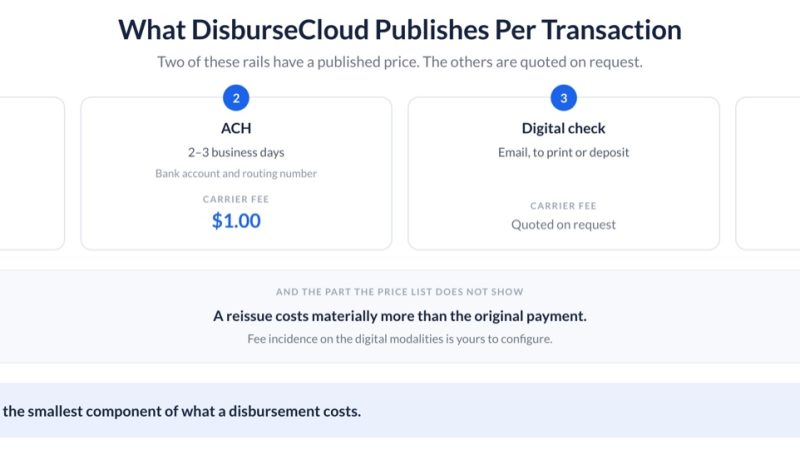
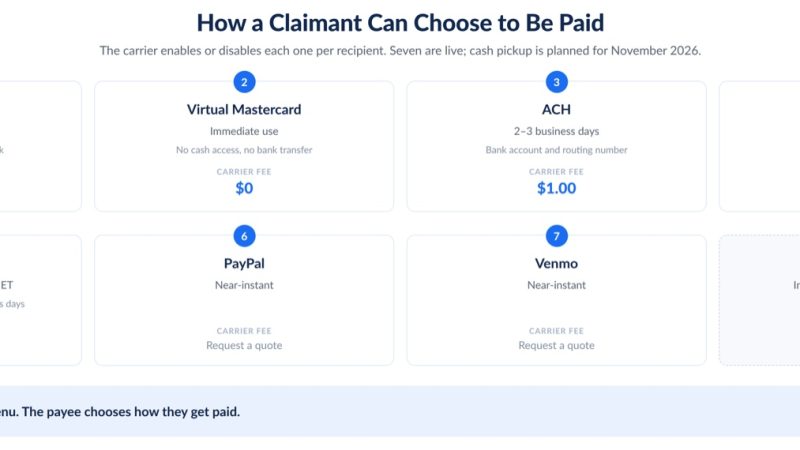
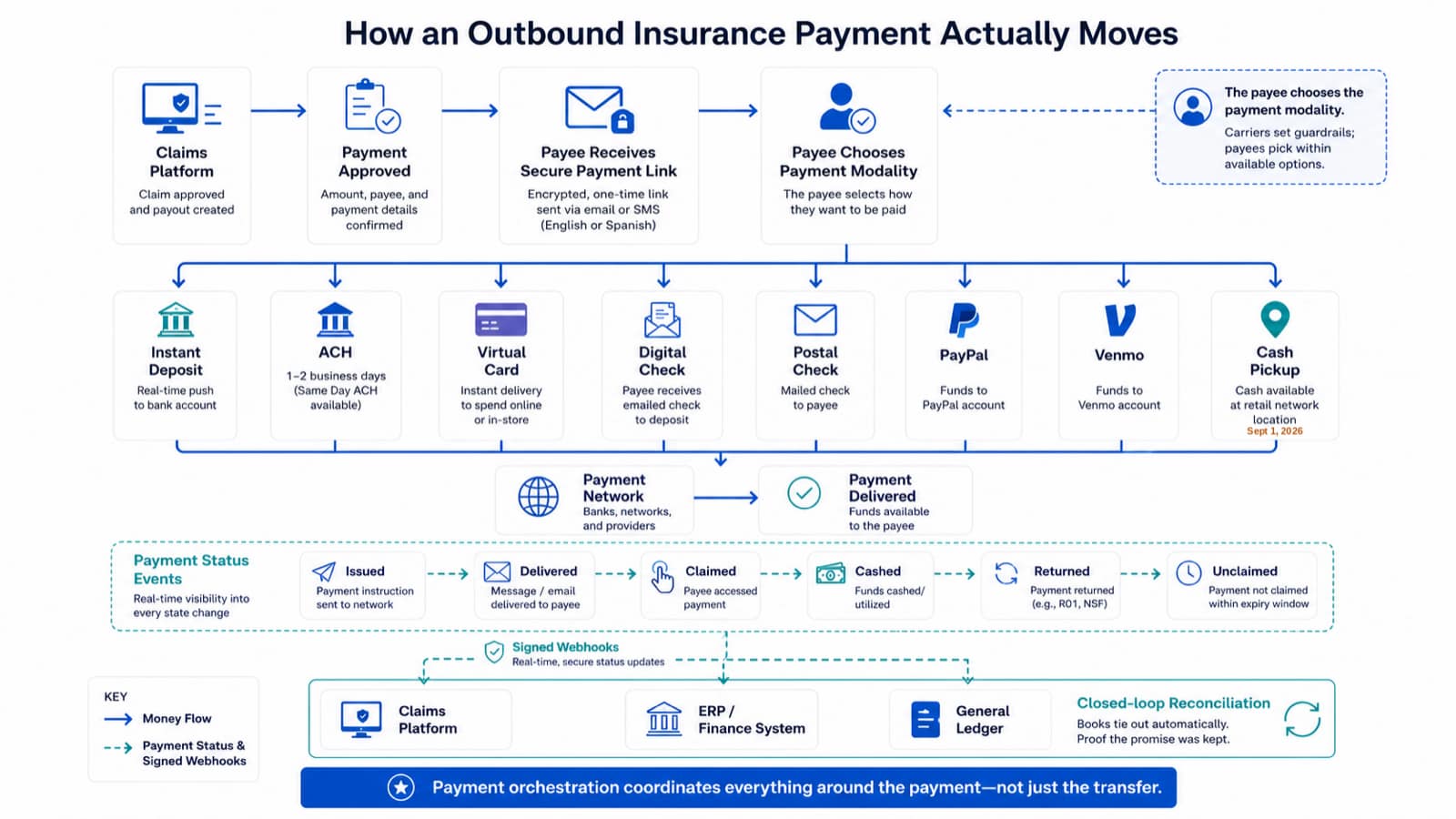
The people being paid choose from a set of payment modalities: instant deposit, virtual card, ACH, digital or postal check, PayPal, Venmo, or cash pickup. Eight modalities in all. The carrier’s rules set which of them a given payee is offered; the payee chooses among those.
The core idea
A processor moves money. Orchestration decides what to tell the processor, and confirms afterward that it worked.
The vocabulary, defined
Five terms do most of the work in this piece, and they are used loosely elsewhere.
| Term | What it means here |
|---|---|
| Payment modality | The form a payment takes, chosen by the payee from the options the carrier has enabled: instant deposit, virtual card, ACH, digital or postal check, PayPal, Venmo, or cash pickup (available 1 September 2026). |
| Payee | Anyone the carrier owes: a claimant on an approved claim, a policyholder due a premium refund, an agent owed a commission, or a vendor. |
| Closed-loop reporting | Every state a payment passes through is reported back to the payer’s system automatically, so the books and the payment never drift apart. |
| Signed webhook | A status message the payer’s system can verify came from the payment system and has not been altered in transit. |
| Idempotent | A message that can be safely retried. If it arrives twice, the payer’s ledger still records the event once. |
How an insurance payment actually moves
Strip a disbursement down and it has four stages.
- An instruction. The carrier, TPA, or MGA approves a payment and names who is owed and how much.
- A modality. The money has to reach the payee somehow. Each modality has its own speed and its own failure pattern.
- Delivery and settlement. The payment makes its way over and the funds become available.
- Reconciliation. The payer’s books record what actually happened.
On paper, that is a clean line. In practice, almost all of the trouble comes from one thing: what the payer can and cannot see between the modality and the reconciliation. If the loop back to the payer’s system exists only on paper, the four stages are really three, followed by silence.
The eight modalities, and what each one asks you to plan for
| Payment modality | Typical speed | Failure pattern to design for |
|---|---|---|
| Instant deposit | Under a minute | Invalid card or account details; network limits |
| Virtual card | Seconds to issue | Card left unactivated or unused; expiry |
| ACH | One to two business days | Wrong routing or account number; return codes |
| Digital check | Emailed same day | Notification undelivered; check never downloaded |
| Postal check | Five to seven business days, including mail time | Lost or stolen in transit; goes stale-dated |
| PayPal | Minutes to hours | Account email mismatch |
| Venmo | Minutes to hours | Handle mismatch; account limits |
| Cash pickup (available 1 September 2026) | Same day at a partner location | ID mismatch; funds never collected |
The speeds above are general characteristics of each rail, not a DisburseCloud performance figure. ACH, for example, settles in scheduled batches on a published timetable rather than continuously.1 The point of the table is the third column: every modality can fail, and each one fails differently, so the workflow has to expect it.
Where the coordination breaks down today
Look at how a typical outbound claim payment moves and the gaps are structural, not accidental. A claims system approves a payout and hands off an instruction. Someone, often a person, picks the modality, usually whatever the default is, because building real choice into the workflow is its own project. A processor moves the money. Reconciliation happens afterward, separately, usually in finance, when someone pulls a bank statement and matches it against the claims system by hand.
Three breakdowns follow from that, and none of them is a failure of the payment rail:
- No stated preference. The modality gets picked without knowing what the payee actually wants, so someone who would rather have a virtual card gets a mailed check anyway.
- A single default method. Paying nearly everyone the same way ignores what the payee can actually use. The mismatch shows up later as delay, reissues, and calls.
- Manual, delayed matching. Without automatic status updates, the payer’s books and the real payment state drift apart until someone chases it down, days or weeks after the transfer.
ACH did what ACH does. The failure is that nothing was coordinating the steps around it. Speed does not fix a handoff; it just gets to the handoff sooner.
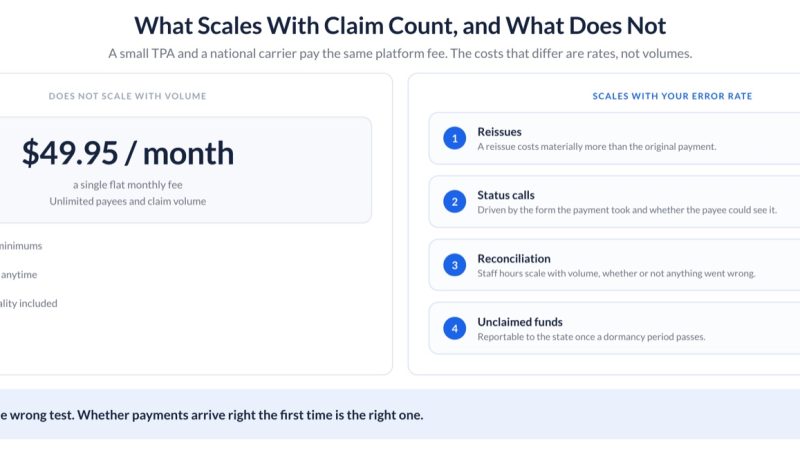
The default itself carries risk. The most common fallback modality, a mailed paper check, is also the one most exposed to fraud. In the 2026 AFP Payments Fraud and Control Survey, drawn from 465 corporate practitioners, checks were again the payment method most frequently hit, with 58 percent of organizations reporting check fraud in 2025 — ahead of ACH debits at 30 percent and wire transfers at 25 percent.2 A default that nobody chose is not a neutral simplification. It is a cost and an exposure that surfaces later, as reissues, stale-dated checks, and “where’s my payment?” calls.
Isn’t this what a payment processor already does?
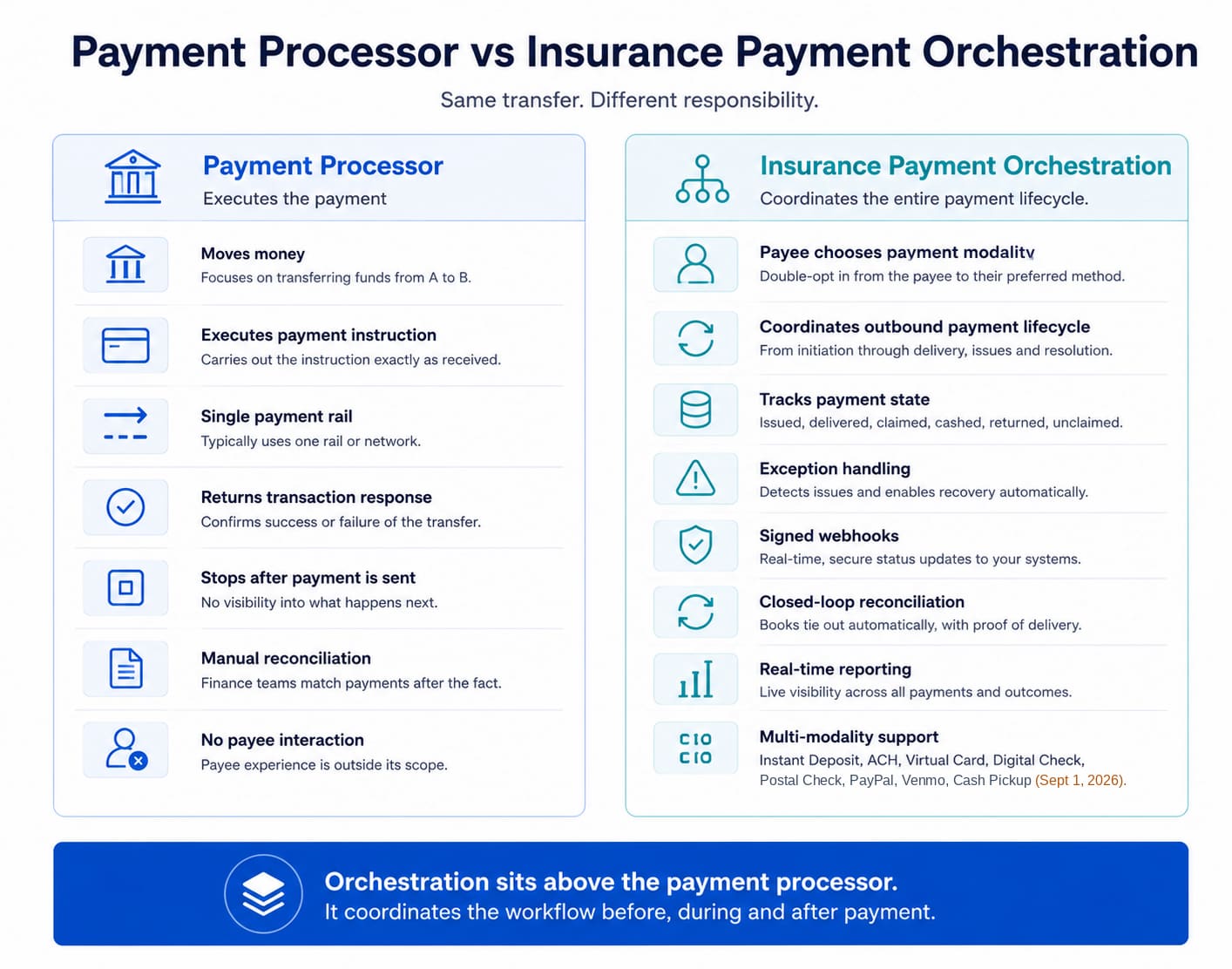
The fair objection is that most insurers already have a payment processor. Isn’t this what they’re paying for? Mostly, no. A processor is built to execute an instruction well: given an account and an amount, move the money reliably. That is valuable, and it is not orchestration.
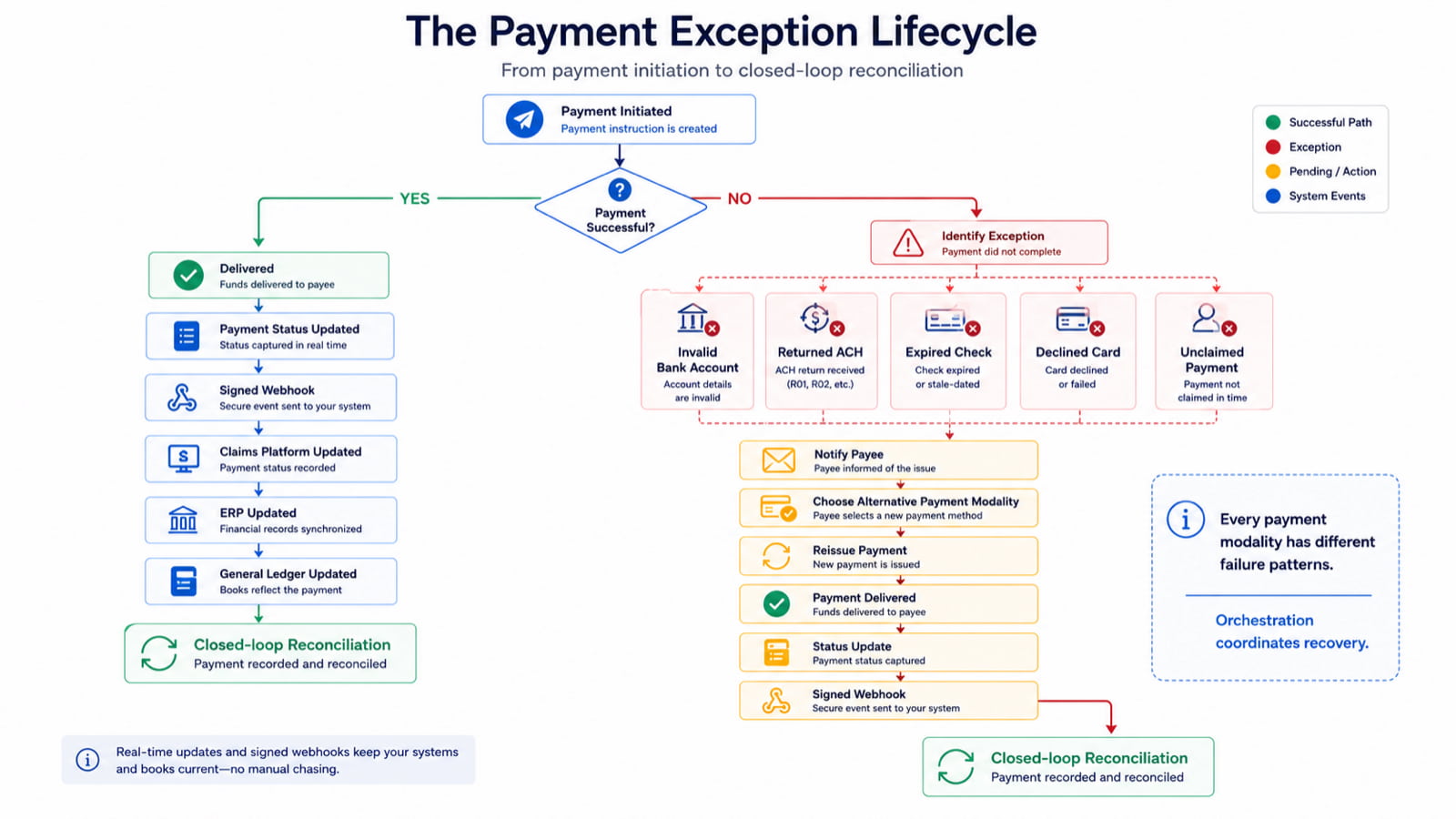
Orchestration sits a layer above. It decides what instruction to send in the first place, based on what the payee actually wants. It tracks the payment’s state after the processor’s job is done, because sent and received and usable are different facts. And it handles what happens when the plan changes, such as a declined card, a closed account, or a check that goes stale, without that becoming a phone call.
| Payment processor | Payment orchestration | |
|---|---|---|
| Core job | Execute one instruction: move a given amount to a given account | Decide the instruction, then coordinate everything around it |
| Payee choice | Not its concern | The payee picks the modality inside the workflow |
| After “sent” | Considers the job done | Tracks state until received and usable |
| On failure | Returns an error or a return code | Surfaces an exception and prompts a new modality |
| Reporting | Confirms the transfer | Reports every state change back over signed webhooks |
| Reconciliation | Left to finance to match by hand | Books stay current automatically |
What a closed loop actually requires
Coordinating the steps around a payment comes down to five things, done consistently rather than fixed one at a time. None of them is exotic. What makes them work is that they are properties of the workflow rather than projects someone gets to eventually.
1. Payee choice inside the workflow
The choice of modality has to sit in the workflow itself, not as a separate project, so a claimant, a policyholder due a refund, an agent, or a vendor can pick from the options the carrier has enabled and actually receive it that way. One secure link, one choice, no follow-up call. The payee’s language belongs in that choice too — a status notification nobody can read is not a status notification.
2. Compliance controls on every payment
Screening and fraud controls belong on each payment, not only on the payee record at onboarding. Sanctions screening against the Specially Designated Nationals list, which the Treasury’s Office of Foreign Assets Control maintains and updates,3 should run at payment creation rather than being inherited from a check someone ran at onboarding months earlier. Account validation belongs before submission, not after a return. On the check side, positive pay through the issuing bank is what makes an altered or forged item detectable before it clears.
3. Real-time reporting
Every state a payment passes through has to report back automatically over a signed webhook rather than a monthly file: issued, delivered, claimed, cashed, returned, and unclaimed. The payer’s system then knows what happened without asking.
4. Exception handling
A bad account number, an expired check, or an unclaimed deposit has to surface on its own instead of waiting for someone to notice a stale balance. Surfacing it early is also what makes a fix cheap: a stale check or a failed deposit can be stopped and reissued on whichever modality the payee prefers, rather than becoming a form and a call to the bank. It matters at the far end too. Under state unclaimed-property regimes, funds left unclaimed generally become reportable and remittable to the state once a dormancy period passes.4 Dormancy periods and filing rules vary by state, and they sit with your compliance and legal teams; the operational job is simply to see the unclaimed payment early enough to act on it.
5. Support for the payee
Payees still have questions, and where those questions land is a design decision, not an accident. If payment-status questions route to a payments team that can see the payment, they get answered. If they route to an adjuster who can see a claim but not a disbursement, they get escalated.
Put those together and a one-way instruction becomes a loop: money goes out in the modality the payee chose, the payer can see every step as it happens, and the books already agree by the time anyone would think to check.
Five questions to ask about your own outbound payments
You can test an existing operation against the same standard without changing a system. Pull one week of outbound payments and ask:
- Did the payee choose? Or did a default choose for them, and how often was that default a mailed check?
- How long is the dark stretch? Between the moment a payment is issued and the moment anyone can confirm it landed, how many days pass, and who could answer in between?
- Who finds the exceptions? Does a returned or uncashed payment announce itself, or does someone find it while reconciling?
- Where do status calls land? Count how many reached adjusters or the claims call center rather than a payments team.
- When do the books agree? On the day of payment, or at month-end after a manual match?
If the answers are uncomfortable, none of them are rail problems. They are coordination problems, and they are fixable without replacing the claims system.
The rail was never the bottleneck
Payment orchestration earns its name from the coordinating, not the moving. The transfer has been fast for years. What still varies enormously from one insurer to the next is whether the payee got a say in how they were paid, whether the payer could see the payment’s status without calling anyone, and whether the books agreed with reality on day one or three weeks later after someone chased it down.
DisburseCloud sits at exactly that layer. It runs the same way for claims payments, premium refunds, and vendor payments, and none of it replaces a payment processor — it is the coordination that decides what the processor is told to do, and confirms afterward that it was done well.
Against the five requirements above, specifically: the payee chooses from a single secure, OTP-gated link, and the link and notifications go out in English or Spanish. Every payee is screened against the OFAC SDN list on every payment rather than once at onboarding, with positive pay on the check side and account validation before submission. Every state change reports back over signed, idempotent webhooks. Exceptions surface on their own, and a stop-and-reissue onto a different modality is one action rather than a process across three teams. And payee questions go to our own US-based agents, in English or Spanish, so the carrier’s call center does not carry them. SOC 2 Type II is the certification to ask us to evidence, and we will send the report rather than the badge.
That is the whole point of the closed loop, and it is why “where’s my payment?” stops being a fact of life. Most of those calls trace back to the same two things: a payment that went out in a form the payee did not want, or on a timeline they could not see. Close that gap, let people choose how they are paid and show them where the money is, and the calls do not get easier to handle. They have less reason to happen.
See it on a real claim file
For the operational detail, including what a payee sees and how multi-party claims settle, read our companion piece on how carriers pay claimants after approval. If you would rather watch it run, we walk through a sample claim in 30 minutes with a CSM: the adjuster view, the payee view, and the webhook trail end to end.
Read: how insurance carriers pay claimants after approval · Schedule a walkthrough
Frequently asked questions
What is payment orchestration in insurance?
Payment orchestration in insurance is the coordination layer around an outbound payment, as distinct from the rail that carries it. It decides what instruction to send based on the payee’s chosen modality, applies compliance and fraud controls to the payment, tracks the payment’s state after it leaves, and reports every change back to the payer’s system so the books stay current.
How is payment orchestration different from a payment processor?
A payment processor executes an instruction: given an account and an amount, it moves the money. Orchestration decides what instruction to send in the first place, based on the payee’s choice, tracks what happens after the processor’s job is done, and handles a change of plan such as a declined card or a stale check without that becoming a support call.
How do insurance claim payouts work, step by step?
A claim payout moves through four coordinated stages: an instruction, in which the carrier, TPA, or MGA approves who is owed and how much; a modality, meaning the payee’s chosen way to be paid; delivery and settlement, when the funds move and become available; and reconciliation, when the payer’s books record what happened. The stages are simple. Keeping them coordinated, so the payer can see status throughout rather than only at the start and the end, is the hard part.
What is closed-loop payment reporting?
Closed-loop payment reporting means every state a payment passes through is reported back to the payer’s system automatically, typically over a signed webhook, so the payer’s books and the actual state of the payment never drift apart. The alternative, a one-way push with no reporting back, is what leaves both payer and payee unable to answer “where’s my payment?” without a phone call.
What payment modalities should insurers offer claimants?
The modalities that matter are the ones a payee would actually choose from: instant deposit, virtual card, ACH, digital or postal check, PayPal, Venmo, or cash pickup (available from 1 September 2026). Constraints differ by person, and someone without a bank account cannot use ACH, so defaulting everyone into a single method, usually a mailed check, is itself a common source of delay, reissues, and calls.
What happens when a payment fails, such as a declined card or a stale check?
In an orchestrated payout, a failed modality surfaces as an exception automatically, whether an expired check, a bad account number, or an unclaimed deposit, rather than sitting quietly until someone notices a balance that will not reconcile. The payee is then prompted to choose an alternative modality instead of waiting for a manual reissue.
Does payment orchestration replace an insurer’s claims or policy admin system?
No. Orchestration sits downstream of the decision. It does not decide whether a claim is payable, set premiums, or adjudicate anything. It starts once the payer’s system has already approved a payment, and handles everything involved in getting that specific payment to the payee and reporting back that it arrived.
References
- Nacha, Same Day ACH Schedules and Funds Availability. https://www.nacha.org/resources/same-day-ach-schedules-and-funds-availability
- Association for Financial Professionals, 2026 AFP Payments Fraud and Control Survey Report, released 14 April 2026, based on 465 respondents; findings cover 2025 activity. https://www.prnewswire.com/news-releases/over-75-of-us-firms-experienced-payments-fraud-in-2025-while-ai-adoption-for-fraud-mitigation-lags-302738857.html
- US Department of the Treasury, Office of Foreign Assets Control, Specially Designated Nationals and the SDN List. https://ofac.treasury.gov/faqs/topic/1631
- National Association of Unclaimed Property Administrators, Reporting Overview. https://unclaimed.org/reporting-overview/
DisburseCloud is the outbound-payment side of the Tranzpay platform. Tranzpay collects premium coming in; DisburseCloud pays everything going out.
Nothing in this article is legal, tax, or regulatory advice. Escheatment, unclaimed property, 1099, and OFAC obligations vary and belong to your compliance and legal teams.