How Do You Pay a Claimant Instantly Instead of Mailing a Check?
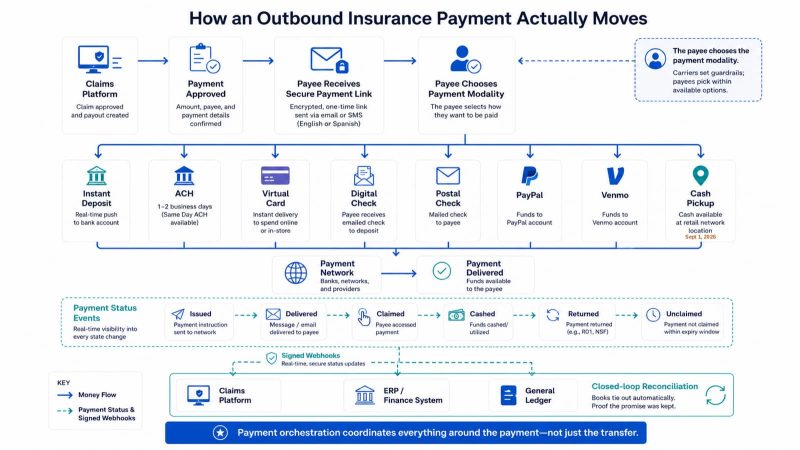
The payee chooses among the modalities your rules allow, and every state change posts back to your claims system as a webhook, in milliseconds.
The bottom line
Replacing a mailed check is not a matter of picking a faster rail. It is a matter of who chooses the rail. On DisburseCloud the carrier’s rules set which modalities a given payee is offered, and the payee picks one from a secure link. Seven are live today and an eighth, in-person cash pickup, is planned for November 2026. Every state change then posts back to the claims system as a webhook, in milliseconds, including which modality the payee selected.
The postal check does not disappear from that picture, and it should not. It is free to the payee, and it mails the same day when the disbursement is submitted before 3:00 PM Eastern. It stays on the menu for payees who need or prefer paper, and for the settlements where a physical instrument is the only thing that works.
What makes a mailed check slow is usually the process around it. A check that mails the same day it is approved is a fast payment. A check that waits for a batch run, then goes to an address the payee left two years ago, is a slow one, and the delay came from the batch cycle and the stale address rather than from the check. The rest of the cost sits in the wait before anyone can confirm delivery, the call that arrives during that wait, and the reissue if the check never reached the payee. Same-day mailing addresses the first part. Visibility addresses the rest.
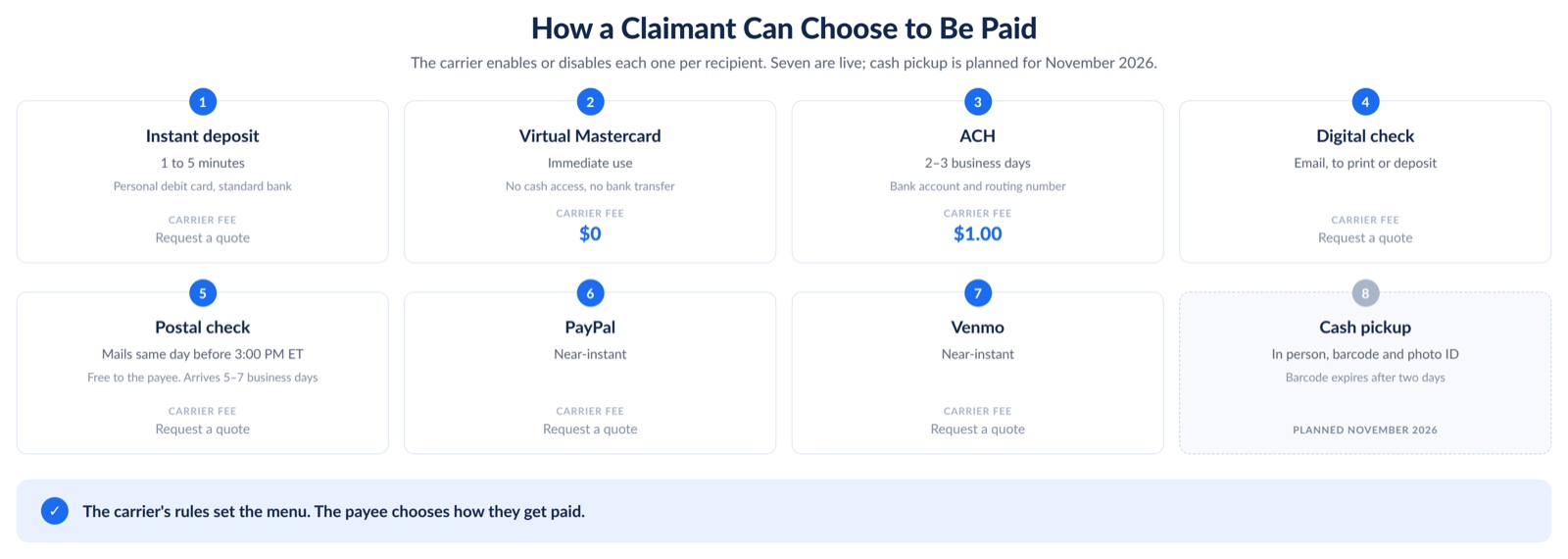
The carrier’s rules set the menu. The payee chooses how they get paid.
What can a claimant actually be paid with?
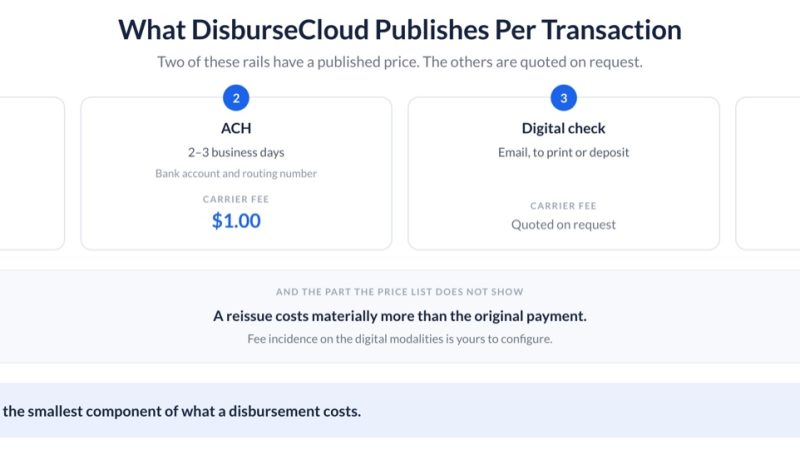
DisburseCloud supports seven live payment modalities, with in-person cash pickup planned for November 2026. Access to all of them is included in the platform fee rather than sold as a separate tier; the per-transaction fee on each is set out below. A carrier enables or disables them per recipient.
| Modality | Speed | Carrier fee |
|---|---|---|
| Instant deposit | 1 to 5 minutes | Quoted rather than published |
| Virtual Mastercard | Immediate use | $0 |
| ACH | 2–3 business days | $1.00 |
| Digital check | Email, to print or deposit | Quoted rather than published |
| Postal check | Mails same day before 3:00 PM ET | Quoted rather than published |
| PayPal | Near-instant | Quoted rather than published |
| Venmo | Near-instant | Quoted rather than published |
| Cash pickup (planned November 2026) | In person, barcode and photo ID | Not yet available |
Postal check is free to the payee and arrives in five to seven business days, up to ten. Cash pickup is planned for November 2026. Fees as published on the DisburseCloud pricing page, 8 September 2026; five of the eight are quoted rather than published.
One is worth pausing on. The virtual card is a virtual Mastercard, it carries no carrier fee, and it reaches an underbanked payee who holds no bank account. It is spent as a card: there is no cash access and no transfer of the balance into a bank account. It does not expire, the payee can add it to a digital wallet if they want to, and support can re-send the details if they are lost. A payee who wants the money in an account should take ACH or instant deposit instead.
Instant deposit carries a constraint worth setting expectations on as well. It pushes to a personal debit card the payee already holds, at a standard bank, which rules out prepaid cards, business accounts, and some digital-first banks including Chime. A payee whose card is ineligible needs another option on the menu, which is the argument for offering the full set rather than one fast rail.
Why does the payee choose rather than the carrier?
Because the carrier does not have the one piece of information that determines whether a payment will succeed on the first attempt, which is what that person can actually receive. A payment that arrives instantly in a form the payee cannot use is not fast. It is a reissue with a shorter fuse.
The mechanism keeps control where it belongs. The carrier’s rules decide which methods are permitted for a given payee, based on line of business and payee type, so finance and compliance still set the boundaries. Within those boundaries the payee selects from a secure link, with any applicable fee visible at the moment of choosing. Nobody guesses.
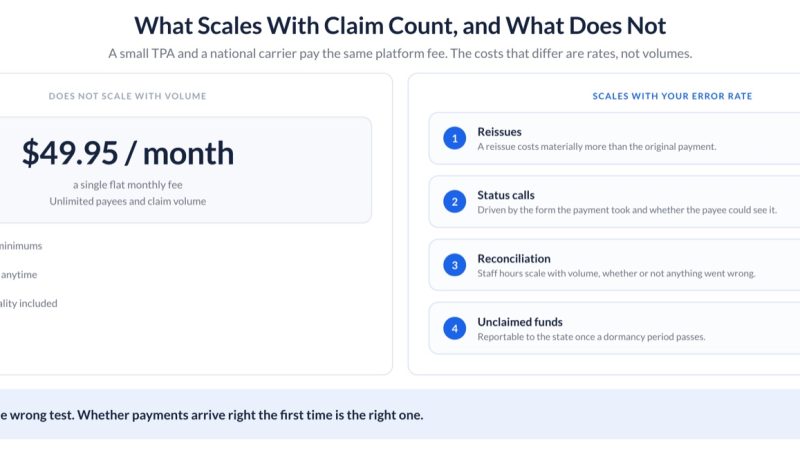
A reissue costs several times what the original payment cost, because the original cost is already spent and the recovery adds a stop-pay fee, staff time, payee contact, a second issuance, and a second pass through reconciliation. Payee choice is the cheapest available control on reissue volume.
What reports back to the claims system
Every state change posts to the carrier’s system as a webhook, in milliseconds, carrying the payment status, the confirmation, and the payment method the payee selected. That last field is what lets a claims record show how a claimant was actually paid, rather than only how the instruction was issued.
The practical test for a claims operation is simple: on the day a payment is issued, can your system tell you what state it is in without anyone making a phone call? If the answer is no, the reconciliation cost is already in your run rate, recorded as headcount rather than as a payment cost.
Connecting to your claims system
Typical go-live is four to six weeks, with portal, API, and SFTP batch routes available depending on how much automation you want on day one.
You do not need to change banks. The platform works alongside existing banking relationships rather than replacing them.
The same workflow covers claims payments, premium refunds, vendor payments, agency commissions, and multi-party payments, so a carrier is not standing up a separate process for each.
The controls around the payment
- Screening. Payees are screened against sanctions lists as part of the disbursement flow.
- Certification. SOC 2, with encryption in transit and at rest and role-based access controls.
- Ledger separation. Segregated ledgers per line of business.
- Payee support. Bilingual English and Spanish support, handled by DisburseCloud rather than landing in your call center. Most tickets resolve the same business day.
- Exception handling. A lost postal check is reissued by stop payment at 15 business days, with no affidavit required. An ACH sent to the wrong account is reissued once the return posts.
Where DisburseCloud fits
DisburseCloud is the outbound payment platform. Tranzpay, from the same company, is the inbound platform for accepting payments, so a carrier can manage both directions of the payment lifecycle through one relationship rather than two vendors.
DisburseCloud is built for carriers, MGAs, TPAs, and claims organizations. The pricing model does not distinguish between them by size: $49.95 a month, unlimited payees and claim volume, no per-transaction minimums, no contract.
See it run on a sample claim
A 30-minute walkthrough with a CSM, using your line of business and your claims system: the adjuster view, the payee view, and the status trail end to end.
Frequently asked questions
How can a carrier pay a claimant instantly instead of mailing a check?
By offering the payee a choice of digital modalities at the moment of payout. Instant deposit lands on a personal debit card the payee already holds, typically in one to five minutes. The virtual Mastercard is usable immediately. ACH takes two to three business days, a digital check arrives by email to print or deposit, and PayPal and Venmo are near-instant. In-person cash pickup is planned for November 2026.
Does the carrier or the claimant choose the payment method?
Both, in sequence. The carrier’s rules decide which modalities a given payee is offered. The payee chooses one of those from a secure link.
What about payees who do not have a bank account?
The virtual Mastercard works without a bank account and can be added to a digital wallet if the payee chooses. It is spent as a card, with no cash access and no transfer of the balance into an account. A postal check also works, free to the payee and mailed the same day when submitted before 3:00 PM Eastern. In-person cash pickup is planned for November 2026.
Do carriers have to stop using paper checks?
No. The postal check is a full option, free to the payee and mailed the same day when the disbursement is submitted before 3:00 PM Eastern. It stays on the menu for payees who need or prefer paper, and for settlements where a physical instrument is required.
How does the claims system find out what happened?
Every state change posts back to the carrier’s system as a webhook, in milliseconds, carrying payment status, confirmations, and the payment method the payee selected.
How long does implementation take?
Typical go-live is four to six weeks, using a portal for a quick launch, an API for automation, or SFTP batch upload for high-volume processing.
Do we need to change our bank?
No. The platform works alongside existing banking relationships.
Sources
- DisburseCloud Pricing — https://www.disbursecloud.com/pricing/
- DisburseCloud FAQ — https://www.disbursecloud.com/faq/
- DisburseCloud Platform Features — https://www.disbursecloud.com/features/
- DisburseCloud Developers and API — https://www.disbursecloud.com/developers/
- What an Outbound Claim Payment Actually Costs, 18 August 2026 — https://www.disbursecloud.com/blog/what-an-outbound-claim-payment-costs/
Nothing in this article is legal, tax, or regulatory advice. Escheatment, unclaimed property, 1099, and OFAC obligations vary and belong with your own counsel.